
Introduction
In modern engineering, understanding how air or fluids move around objects is essential for designing efficient and reliable products. This is where Computational Fluid Dynamics, or CFD, comes in. CFD helps engineers simulate how gases and liquids behave in different conditions. Instead of guessing or building expensive physical prototypes, we can now test ideas virtually.
From improving the airflow over a drone or a car to making sure a cooling system works properly in an electronics enclosure, CFD plays a key role. In this article, we will look at what CFD is and compare four popular CFD tools: Ansys Fluent, COMSOL Multiphysics, SolidWorks Flow Simulation, and STAR-CCM Plus. Each of these tools has its strengths, and we will explore which one might be right for your project.
What Is CFD and Why Is It Useful?
CFD stands for Computational Fluid Dynamics. It is a way of using computer software to model how fluids like air, water, or gas behave. Engineers use CFD to analyze things like:
- How air flows around an airplane wing
- How water moves through a pipe system
- How heat transfers in electronic devices
- How fluids mix in chemical processes
By running CFD simulations, engineers can see things like pressure, velocity, temperature, and flow paths. This helps them improve designs, save time, and avoid costly mistakes later.
Where CFD Is Commonly Used
CFD is widely applied across industries, including aerospace and automotive to reduce drag and improve fuel efficiency; HVAC engineering to design better ventilation and cooling; electronics design to prevent component overheating; and medical engineering to simulate blood flow etc. One of its most common applications is airflow analysis examining how air moves through or around objects, to optimize performance, reduce noise and improve comfort.
Comparing Popular CFD Software Tools
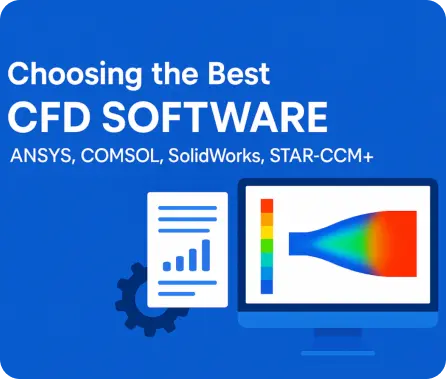
There are many CFD tools out there, but four are widely used by professionals: Ansys Fluent, COMSOL, SolidWorks Flow Simulation, and STAR-CCM Plus. Let us look at what each one offers.
If you want high precision for large projects, Ansys or STAR-CCM Plus are top choices. If you are already using SolidWorks, then its built-in CFD module is quick and convenient. If your project combines fluid flow with electricity, heat, or stress analysis, COMSOL is great for that.
How to Choose the Right One
When deciding which CFD tool to use, think about:
- What type of project you are working on
- How accurate the results need to be
- Whether you are already using a CAD tool like SolidWorks
- If your simulation involves more than just fluid flow
- Your budget and software access
For example, if you are designing a new drone and want to analyze airflow around the wings, Ansys or STAR-CCM Plus would work well. If you are checking ventilation in a warehouse, SolidWorks Flow Simulation might be easier. If you are modeling a lab-on-a-chip device that mixes fluids and electric currents, COMSOL is probably the best choice.
If you want high precision for large projects, Ansys or STAR-CCM Plus are top choices. If you are already using SolidWorks, then its built-in CFD module is quick and convenient. If your project combines fluid flow with electricity, heat, or stress analysis, COMSOL is great for that.
Final Thoughts
CFD is no longer just for experts in big companies. Thanks to powerful tools like Ansys, COMSOL, SolidWorks, and STAR-CCM Plus, engineers in all industries can now use simulation to improve their designs. Whether you are looking at airflow, cooling, or fluid performance, CFD gives you the insight you need before making physical prototypes.
By learning how each software works and matching it to your needs, you can make better design choices and save time in your engineering process.