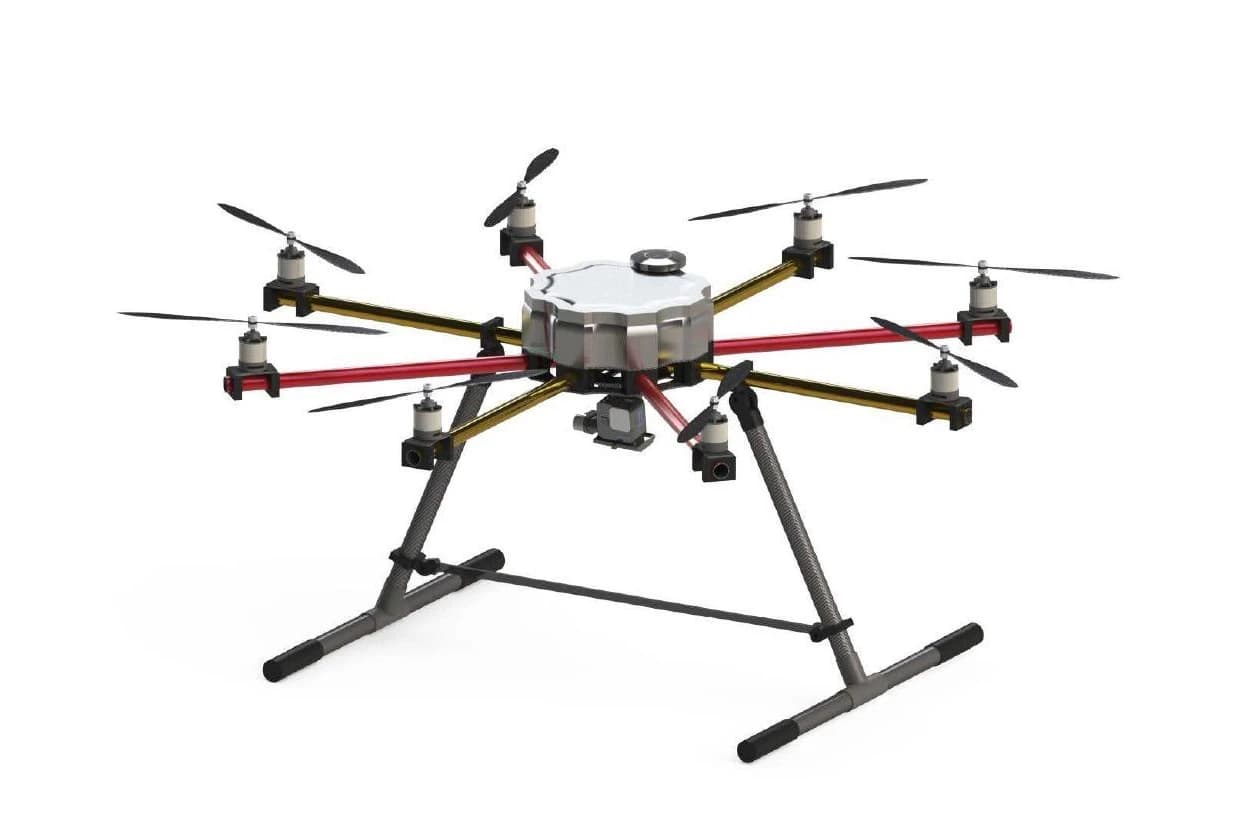
Project overview
With eight rotors, an octacopter can lift heavier payloads than a quadcopter and keep flying if a motor fails, which makes it a common choice for professional camera and survey work. Turning a drone concept into one that can be built takes more than a 3D model, though: every part has to be defined, dimensioned and listed.
Our team designed the octacopter in SolidWorks and produced the complete package for manufacturing: the 3D assembly, detailed technical drawings and a comprehensive bill of materials (BOM), taking the design from concept to something a workshop can make.
Objectives
The design
| Feature | Design | Notes |
|---|---|---|
| Layout | Octacopter | Eight arms, each carrying a motor and a two-blade propeller |
| Centre | Central hub | The body that the arms and the landing gear attach to |
| Payload | Camera gimbal | Mounted under the hub |
| Landing gear | Two skids | Braced to each other below the hub |
Deliverables
The drawings carry the dimensions needed to make each part, and the BOM lists every part with its quantity, so purchasing, costing and assembly all work from the same source. That is what separates a design that looks right on screen from one that can actually be built.
Frequently asked questions
What is included in production-ready CAD files?
The 3D model and assembly, technical drawings with the dimensions needed to make each part, and a bill of materials, in formats that manufacturers and suppliers use, so parts can be made and bought without guesswork.
What is a bill of materials (BOM)?
A structured list of every part in an assembly, with part numbers, quantities and descriptions, used for purchasing, costing and assembly.
Why choose an octacopter over a quadcopter?
Eight rotors give more lift for heavier payloads, and redundancy: an octacopter can usually stay in the air if one motor fails, which matters when it carries an expensive camera or sensor.
Which software was used?
SolidWorks, for the 3D assembly, the technical drawings and the bill of materials.