
Home / Projects / 1U CubeSat Thermal-Mechanical (Coupled) Stress Analysis
1U CubeSat Thermal-Mechanical (Coupled) Stress Analysis
Project Summary
This project focused on performing a detailed coupled thermal and mechanical stress analysis of a standard 1U CubeSat intended for low Earth orbit operations. The objective was to study how combined temperature variations and mechanical loads would influence the overall structural integrity of the satellite during its mission lifecycle. These conditions included the high mechanical stresses generated during the launch phase and the large temperature fluctuations experienced in space as the CubeSat transitions between sunlight and shadowed regions of orbit.
The analysis was designed to represent realistic mission conditions. This involved applying both transient thermal cycles and mechanical load cases simultaneously to evaluate the satellite's ability to withstand operational extremes. Advanced finite element analysis (FEA) techniques were utilized to establish an accurate multiphysics simulation environment capable of capturing temperature-dependent material behavior and stress response. The coupled simulation helped predict how thermal expansion, contraction, and structural deflection interact when exposed to space conditions.
Objectives and Approach
The core goal of this study was to ensure that the CubeSat's structural design could sustain combined loading without failure, deformation, or functional compromise. Specific objectives included:
- Determining how temperature gradients influence the distribution of stress and strain within the satellite's structural frame.
- Simulating the dynamic acceleration and vibration effects experienced during rocket launch.
- Identifying stress concentrations, potential failure zones, and the influence of material choices under combined thermal-mechanical loading.
- Providing recommendations for improving the CubeSat's mechanical stability and thermal resilience through minor geometric or material adjustments.
A high-fidelity finite element model of the CubeSat's structure was developed for the analysis. The model included all key subsystems such as outer panels, internal frames, fasteners, and PCB mounting surfaces. Special attention was given to mesh refinement in areas near screw holes, joints, and electronic housing interfaces where local stress peaks were anticipated. The thermal environment was modeled using a transient heat transfer analysis, followed by a fully coupled thermal-structural simulation to assess the mechanical response induced by temperature variations.
Simulation Conditions and Assumptions
The coupled analysis accounted for the extreme environmental and operational loads typical of CubeSat missions. The following conditions and parameters were considered:
- Thermal cycling between –40°C and +85°C to represent orbital exposure to sunlight and Earth shadow.
- Heat flux boundary conditions corresponding to solar radiation and radiation to deep space.
- Structural loads corresponding to launch acceleration up to 20 g, applied in multiple directions to simulate dynamic excitation.
- Material properties based on aerospace-grade aluminum alloy 7075-T6 for the main frame and thermally stable polymer composites for electronic component housings.
- Fixed boundary constraints were applied at the deployer interface points, while time-dependent conditions captured temperature and stress variation during a complete orbit cycle.
All analyses were performed using advanced solver algorithms to ensure convergence under nonlinear temperature-dependent material properties. The coupling between the thermal and mechanical solvers allowed accurate prediction of the interaction effects, including differential expansion, thermal stress accumulation, and fatigue potential under repeated thermal cycles.
Results and Findings
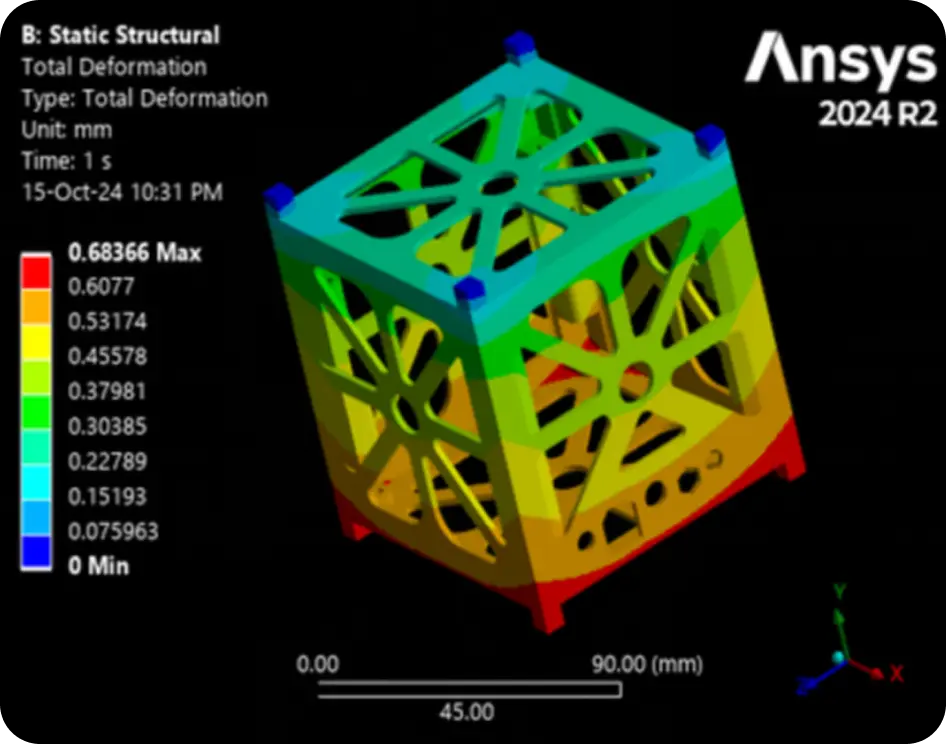
The coupled thermal-mechanical analysis provided key insights into the CubeSat's performance under realistic conditions. The results showed that the structural configuration remained within acceptable stress limits under all simulated scenarios, but several notable findings emerged.
Localized thermal gradients caused small but measurable deformations around the mounting brackets and hinge connections, suggesting the potential for minor misalignments in the deployment mechanism. The highest stress concentrations appeared near internal joint intersections and cutout edges of the panels. Under combined thermal and mechanical loading, the peak Von Mises stress increased by approximately 15–18 percent compared to mechanical-only simulations. This demonstrated the critical influence of thermal effects on the overall stress field.
Based on the results, minor geometric improvements were recommended, including the addition of fillets at sharp intersections and optimization of panel thickness to enhance stiffness while maintaining mass constraints. The modified design achieved better thermal stress distribution, improved load transfer efficiency, and reduced the risk of fatigue or deformation during launch and orbital operation.
The study successfully demonstrated that coupled multiphysics simulation is essential for ensuring the durability and reliability of CubeSat structures. The findings contributed to a more robust satellite design capable of withstanding the harsh mechanical and thermal conditions encountered in space missions.
Our Projects
See how Solvo Products has helped its clients achieve their vision of digital innovation.
Our Technologies
 Contact Us
Get in touch with us