
Home / Projects / FEA Analysis of Nylon Injection Moulding Part
FEA Analysis of Nylon Injection Moulding Part
Project Summary
This project focused on the structural performance evaluation of a nylon-based injection-moulded bracket using Finite Element Analysis (FEA). The component was designed for use in an industrial setting, where it would experience moderate to high mechanical loads during service. The goal of the analysis was to validate the part's mechanical strength, deformation behavior, and overall reliability under expected load conditions, while accounting for the material properties of nylon, a commonly used engineering thermoplastic.
This simulation was performed using ANSYS 2024 R2 and incorporated accurate material modeling and load application to replicate real-world performance. The client required confidence in the design prior to tooling and production, especially considering the cost-intensive nature of injection mould manufacturing.
Objectives and Approach
The primary objectives of this FEA project were:
- To assess total deformation under static structural loading.
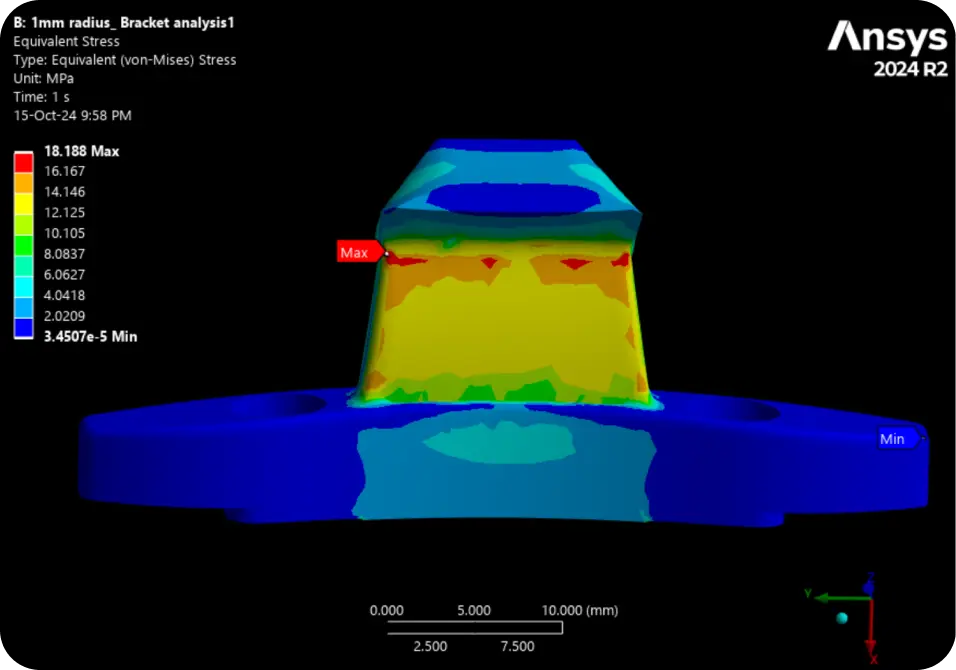
- To identify critical stress regions based on von Mises criteria.
- To evaluate shear strain and understand material behavior at connection points.
- To optimize geometry for durability while ensuring manufacturability.
A 3D CAD model of the bracket was imported and prepared for meshing. Due to the complex geometry and filleted features, mesh refinement was applied to high-stress regions, especially around the load-bearing supports and the mounting hole. Nylon's nonlinear elastic-plastic behavior was approximated using available material data, and appropriate boundary conditions were applied to simulate realistic fixture points and external loading.
Simulation Setup and Conditions
The simulation was performed using Nylon 66 (glass-filled) as the material, with its corresponding Young's modulus, Poisson's ratio, and yield strength accurately defined to reflect realistic behavior under load. Fixed supports were applied at the bolt holes to simulate actual mounting conditions, while a downward force was applied on the upper face to represent the service load. The model was meshed using tetrahedral elements, with finer refinement around fillets and holes to capture stress concentrations more precisely. The Static Structural solver in ANSYS Mechanical was employed for the analysis. The key outputs analyzed included total deformation, von Mises stress, and shear strain, providing a comprehensive understanding of the part's structural response.

Results and Findings
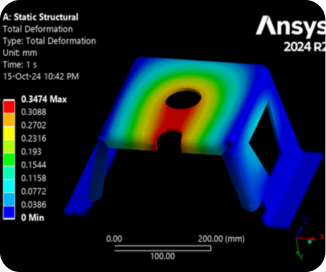
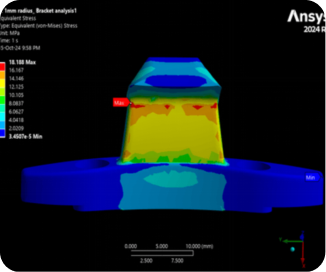
The simulation results showed a maximum total deformation of 0.3474 mm, occurring near the central hole region. This deformation was well within acceptable limits, aligning with the inherent flexibility of Nylon 66. The equivalent (von Mises) stress reached a peak value of 18.18 MPa, which is below the material's yield strength, confirming the structural safety and integrity of the design under service conditions. Localized shear strain was detected around the mounting base, but all values remained under threshold limits, indicating no risk of material failure. Overall, the analysis validated the part's ability to perform safely under load, while minor design optimizations—such as enhancing local fillets and adding reinforcing ribs in the loading direction—were recommended to further improve stiffness and long-term durability.
Our Projects
See how Solvo Products has helped its clients achieve their vision of digital innovation.
Our Technologies
 Contact Us
Get in touch with us