
Home / Projects / CFD Analysis of Compressible Flow in a Converging-Diverging Nozzle Using Ansys Fluent
CFD Analysis of Compressible Flow in a Converging-Diverging Nozzle Using Ansys Fluent
Project Summary
This project presents a detailed Computational Fluid Dynamics (CFD) analysis of compressible airflow through a two-dimensional converging-diverging (CD) nozzle using Ansys Fluent. The primary aim was to investigate how subsonic flow accelerates to supersonic speeds, observe changes in static pressure and Mach number along the nozzle, and evaluate the flow regime under choked and expanded conditions.
CD nozzles are crucial components in propulsion systems, especially in aerospace and defense industries, where the conversion of thermal energy into directed kinetic energy is essential for producing thrust. This CFD simulation helped in visualizing how flow behaves under high pressure ratios, enabling better understanding and design of nozzle-based exhaust and propulsion systems.
Objectives and Approach
The key objectives of this project were:
- To perform a steady-state CFD simulation of compressible flow in a CD nozzle using a 2D axisymmetric model.
- To analyze the Mach number distribution through the nozzle, focusing on the transition from subsonic to supersonic flow.
- To study the static pressure drop and pressure wave propagation along the nozzle geometry.
- To assess nozzle performance under typical pressure ratios observed in aerospace applications.
The approach involved creating a high-quality 2D structured mesh of the nozzle geometry with mesh refinement near the throat and outlet regions to accurately capture pressure gradients and shock formations. The simulation was set up using Ansys Fluent, with appropriate boundary conditions applied for compressible flow modeling.
Simulation Setup and Conditions
- Solver: Density-based solver for compressible, steady-state flow
- Working Fluid: Air, modeled as an ideal gas
- Inlet Boundary: Total pressure inlet with elevated pressure to simulate choking and expansion
- Outlet Boundary: Static pressure set to atmospheric conditions
- Turbulence Model: SST k-omega, selected for its balance of accuracy in boundary layer and shock resolution
- Wall Conditions: Adiabatic and no-slip
- Geometry: 2D axisymmetric CD nozzle with converging throat and smooth diverging outlet
The pressure ratio across the nozzle was chosen such that choked flow was achieved at the throat, followed by supersonic expansion in the divergent section.
Results and Findings
Two main result variables were examined — Mach number distribution and static pressure distribution.
Mach Number Distribution:
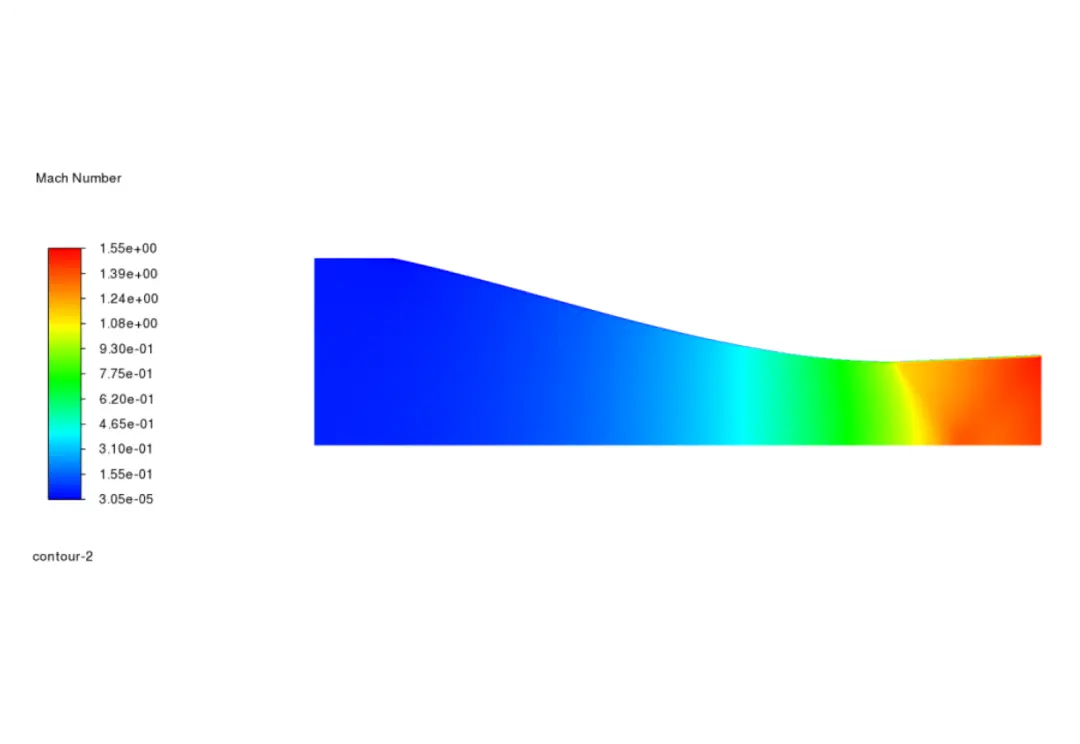
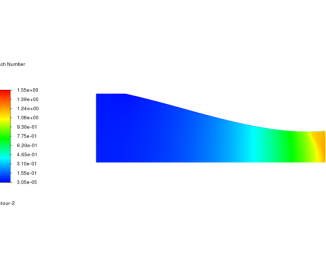
The Mach number contour clearly shows the acceleration of flow from subsonic (blue) in the converging section to Mach 1 at the throat, and further increase to Mach 1.55 (red) in the divergent section. The continuous color transition confirms a smooth acceleration and validates the presence of supersonic flow, typical in well-designed CD nozzles under the given boundary conditions. The results match closely with isentropic flow theory, indicating the absence of shock waves in the current condition.
Static Pressure Distribution:
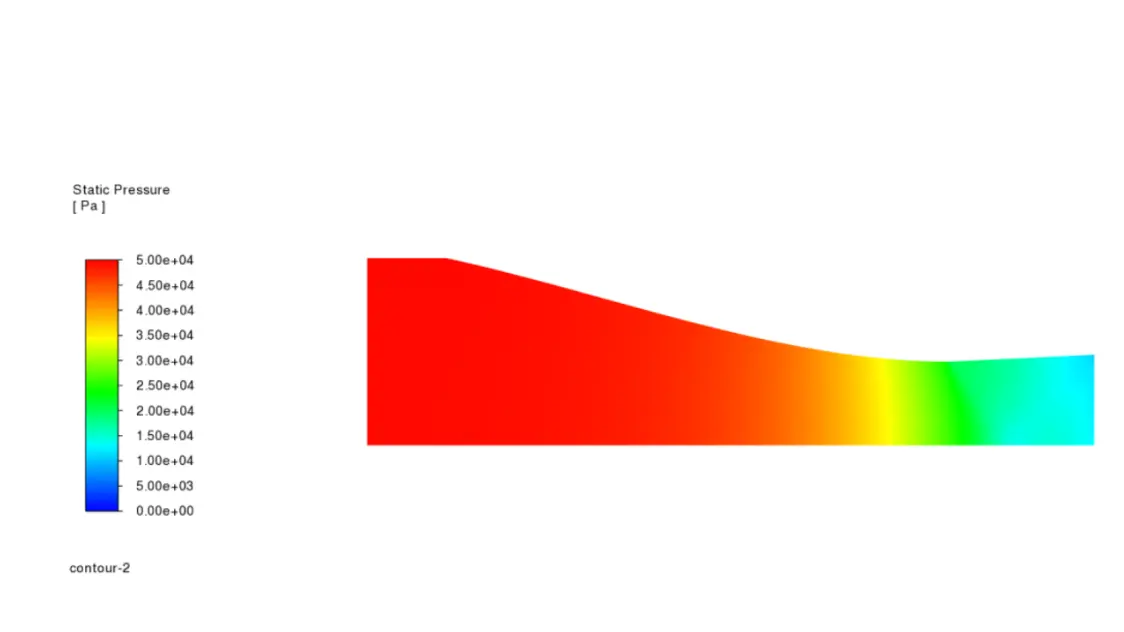
The static pressure contour reveals a strong pressure drop along the nozzle. The pressure is highest at the inlet (red) and reduces progressively towards the outlet (cyan), which corresponds to the expansion of the flow as it accelerates. The color gradient suggests efficient energy conversion from pressure to kinetic energy. No adverse pressure gradients or backflow were observed, confirming the nozzle operates in a well-expanded regime under these conditions.
Conclusion
This CFD study successfully demonstrated the application of Ansys Fluent for simulating compressible flow through a converging-diverging nozzle. The simulation results provided valuable insights into how pressure and velocity vary throughout the nozzle, helping identify conditions for optimal expansion and thrust generation.
The project confirms that Computational Fluid Dynamics is an essential tool for analyzing high-speed internal flows in propulsion systems. Engineers can rely on such simulations to validate nozzle designs, optimize performance, and minimize costly physical testing in early-stage development.
Our Projects
See how Solvo Products has helped its clients achieve their vision of digital innovation.
Our Technologies
 Contact Us
Get in touch with us