
Fluent vs STAR-CCM+ at a glance
The short version, feature by feature. The sections below explain what each difference means for a real project.
| Ansys Fluent | Simcenter STAR-CCM+ | |
|---|---|---|
| Developer | Ansys Fluent: Ansys, part of Synopsys since 2025 | Simcenter STAR-CCM+: Siemens Digital Industries Software (Simcenter) |
| Numerical method | Ansys Fluent: Finite volume, cell-centred | Simcenter STAR-CCM+: Finite volume, cell-centred |
| Workflow | Ansys Fluent: Geometry in SpaceClaim or Discovery, meshing and solving in Fluent, linked through Workbench | Simcenter STAR-CCM+: One environment from CAD import to mesh, solution and report |
| Meshing | Ansys Fluent: Watertight and fault-tolerant workflows, Mosaic poly-hexcore meshes | Simcenter STAR-CCM+: Surface wrapper, polyhedral and trimmed-cell meshers with prism layers |
| Turbulence models | Ansys Fluent: Spalart-Allmaras, k-ε and k-ω families including GEKO, transition, RSM, SAS, DES and LES | Simcenter STAR-CCM+: Spalart-Allmaras, k-ε (including elliptic blending) and k-ω families, transition, RSM, DES and LES |
| Multiphase | Ansys Fluent: VOF, mixture, Eulerian and discrete particles; DEM through Ansys Rocky | Simcenter STAR-CCM+: VOF, mixture, Eulerian, Lagrangian particles and built-in DEM |
| Combustion and chemistry | Ansys Fluent: One of the broadest model sets: flamelet, premixed, EDC and detailed chemistry with Ansys Chemkin | Simcenter STAR-CCM+: Strong: flamelet, FGM, complex chemistry and in-cylinder engine models |
| Moving parts | Ansys Fluent: Dynamic, sliding and overset meshes | Simcenter STAR-CCM+: Overset, morphing and sliding meshes, with rigid-body motion (DFBI) |
| Structural coupling | Ansys Fluent: Two-way FSI with Ansys Mechanical through System Coupling | Simcenter STAR-CCM+: Built-in finite element stress solver, or co-simulation with Abaqus |
| Customisation | Ansys Fluent: UDFs in C, journals and PyFluent (Python) | Simcenter STAR-CCM+: Java macros, field functions and user code libraries |
| GPU solving | Ansys Fluent: Native multi-GPU solver for many flow types | Simcenter STAR-CCM+: GPU-native solvers for many flow types |
| Licensing for many cores | Ansys Fluent: 4 cores per solver licence; more through HPC Packs, HPC Workgroup or pay-per-use Elastic licensing | Simcenter STAR-CCM+: Power Session: unlimited cores per session; Power on Demand: pay by the hour |
| Learning and hiring | Ansys Fluent: Free student version, widely taught, the most courses and forum answers | Simcenter STAR-CCM+: Mainly university licences; thorough documentation, smaller community |
| Most common in | Ansys Fluent: Aerospace, energy, process industry, electronics cooling, universities | Simcenter STAR-CCM+: Automotive, motorsport and marine |
Accuracy: the same physics gives the same answer
Both codes solve the same equations with the finite volume method, and both have been checked against the same classic test cases for decades. On an identical mesh, with the same turbulence model and wall treatment, their results agree closely. When two teams get different answers from Fluent and STAR-CCM+, the cause is almost always the mesh, the wall treatment or a model setting, not the code.
The wall treatment is a good example. STAR-CCM+ uses its All y+ wall treatment by default, and the k-ω models in Fluent are built to be insensitive to y+, so both tolerate a first cell that lands in the buffer layer. Results still drift when the first cell height is far from what the model expects, so we size the boundary layer with our y+ calculator before meshing, whichever code we use.
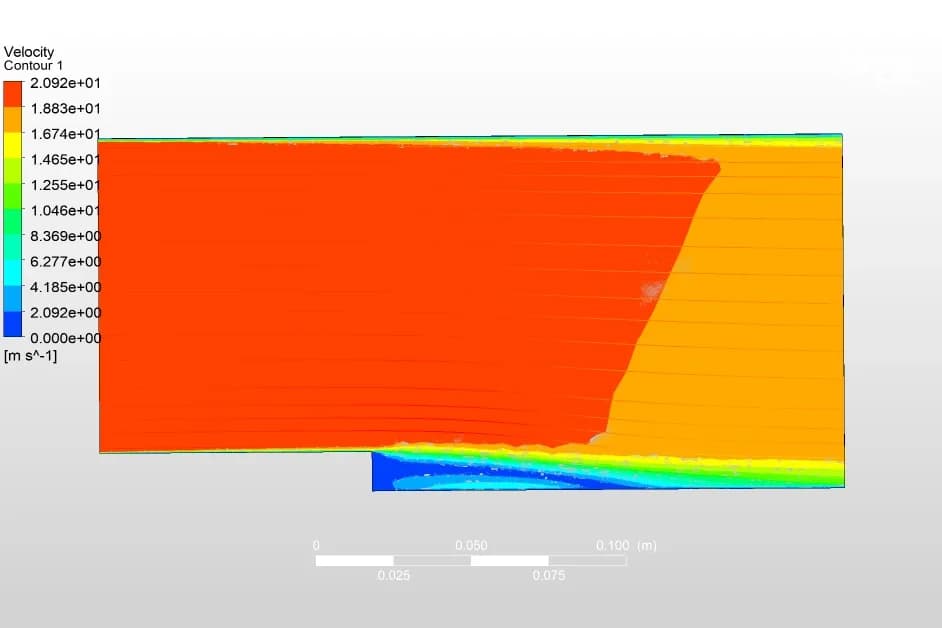
Validation matters more than the brand. In our backward-facing step study, we compared the wall pressure from Fluent with Driver's 1985 experiment before trusting the model. The same check works in STAR-CCM+, and it is the step that makes either code's results worth acting on.
Meshing and geometry preparation
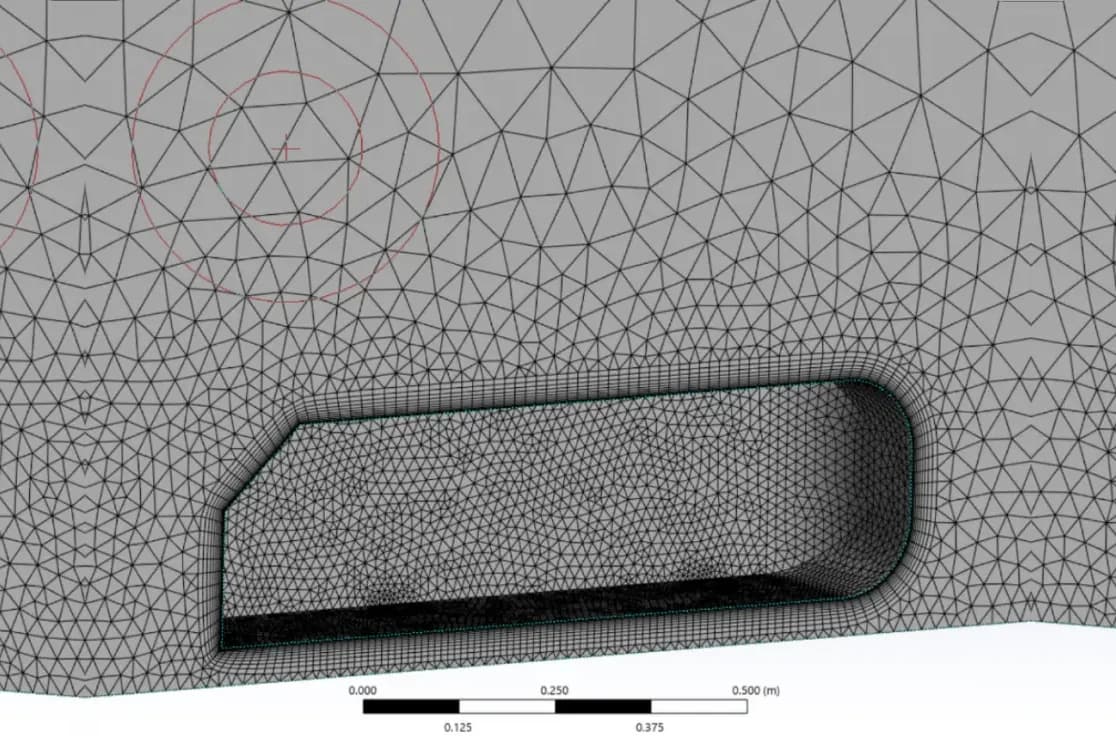
Meshing is where the day-to-day difference shows most. STAR-CCM+ was built around automated meshing: the surface wrapper closes gaps and overlaps in messy CAD, then the polyhedral or trimmed-cell mesher with prism layers meshes hundreds of parts in one pipeline. Change the geometry and the whole chain runs again.
Fluent has closed most of that gap. Its watertight workflow handles clean CAD in a few guided steps, the fault-tolerant workflow wraps dirty assemblies, and Mosaic poly-hexcore meshes fill the volume with hexahedra joined to polyhedra near the walls, which keeps cell counts down for the same accuracy.
Our view: for clean CAD of a single part, both are quick. For a full vehicle, an engine bay or a building with hundreds of parts, STAR-CCM+'s single pipeline still saves the most hours.
Physics and multiphysics
Fluent has one of the broadest model libraries in CFD. Combustion is its strongest area, with flamelet, premixed and EDC models and detailed chemistry, and its discrete phase, Eulerian and VOF multiphase models are mature. When a piece of physics isn't in the menu, a user-defined function written in C can add it.
STAR-CCM+ keeps more of the multiphysics in one place: discrete element particles, electrochemistry and a finite element stress solver all live in the same simulation file. Fluent reaches the same physics through the wider Ansys family, with Mechanical for structures, Maxwell for electromagnetics and Rocky for particles, linked through Workbench and System Coupling.
For conjugate heat transfer, rotating machinery, aeroacoustics and free-surface flow, both are fully capable. There, the choice comes down to the workflow rather than the physics.
HPC and licensing costs
Licensing changes the economics of large models more than any feature. Each Ansys solver licence includes 4 cores. Beyond that, Fluent needs HPC licences (HPC Packs or an HPC Workgroup) or pay-per-use Elastic licensing, so every extra block of cores has a price.
Siemens licenses STAR-CCM+ differently. A Power Session licence runs one simulation on as many cores as you have, and Power on Demand charges by the hour with no core limit. For a team that runs large transient or scale-resolving cases on a cluster, that can make STAR-CCM+ much cheaper at high core counts.
Prices depend on the region, the reseller and the contract, so ask both vendors for a quote based on your real core count and hours of use. Our own team runs Fluent, Ansys Mechanical and LS-DYNA on HPC licences, so large models solve in parallel instead of over days.
Automation and design studies
Both can run a parameter study overnight. In Fluent, journals and the PyFluent Python library script the whole run, and Workbench parameters feed optimisation tools such as optiSLang. In STAR-CCM+, Java macros and simulation operations automate the pipeline, and Design Manager runs and ranks the variants inside the same tool, with HEEDS for larger optimisation studies.
If your work is mostly design exploration on a changing geometry, STAR-CCM+'s all-in-one pipeline is the simpler one to keep running. If you want CFD inside a Python workflow, PyFluent is the easier way in.
Learning curve, support and hiring
Fluent is the CFD code most engineers meet first. Ansys offers a free student version, most universities teach it, and its forums and online courses answer almost any setup question. That also makes Fluent users easier to hire.
STAR-CCM+ is mostly learned through university licences or on the job. Its single interface is consistent once learned, and Siemens' documentation and tutorials are thorough, but the community is smaller, so expect fewer ready-made answers online.
Which one do we use?
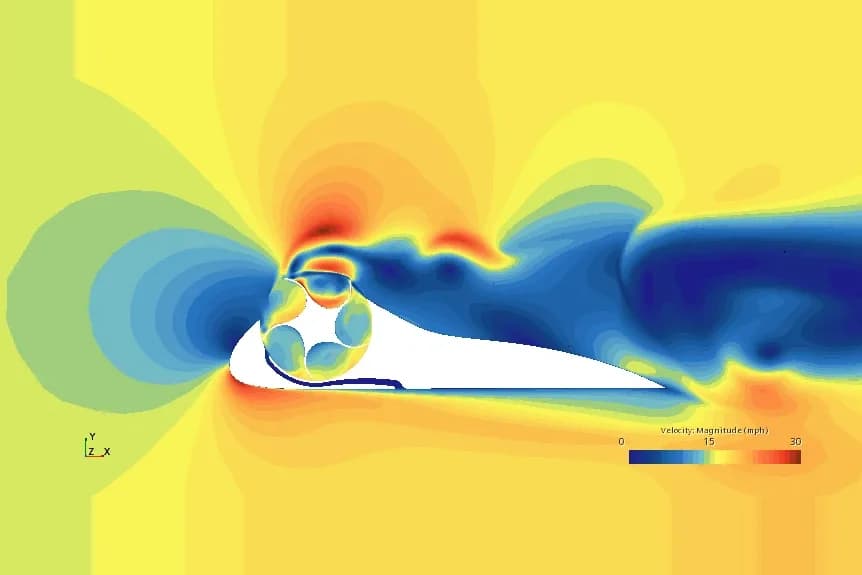
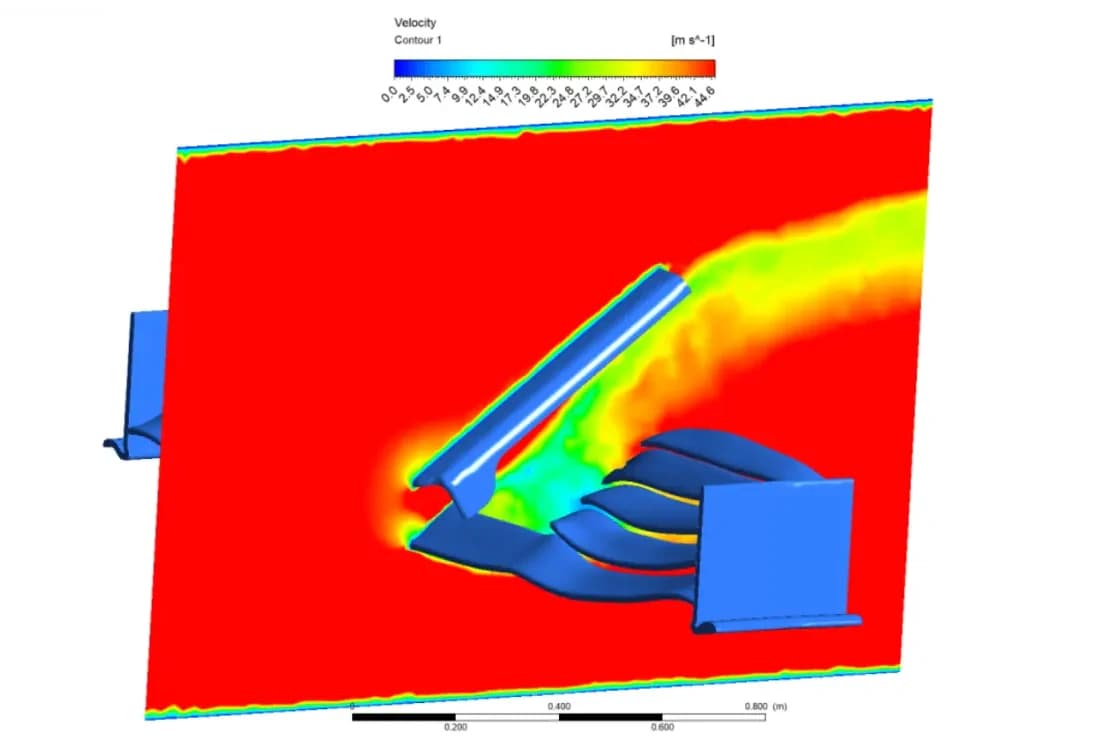
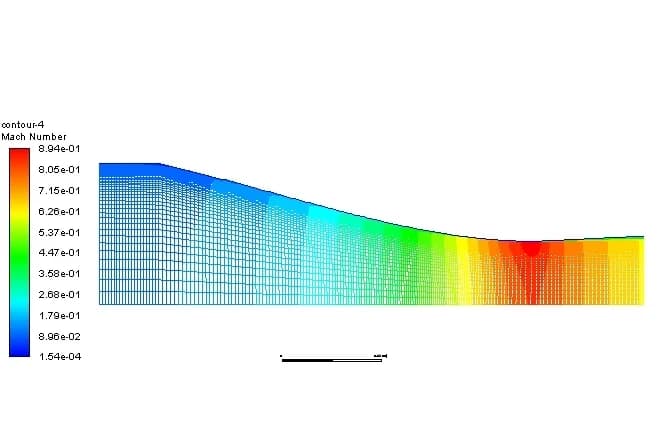
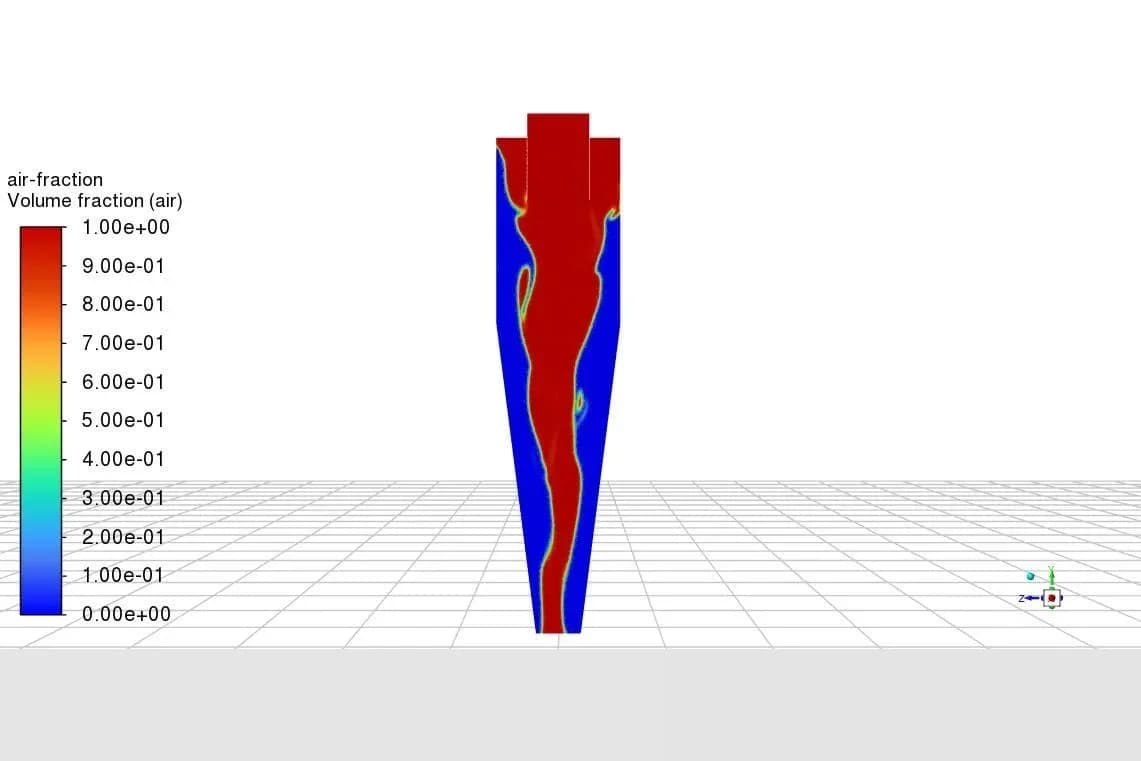
Both. Most of our published CFD projects run in Ansys Fluent, from the Ahmed body and the Mercedes W11 front wing to supersonic nozzle flow and free-surface tank filling. We used Simcenter STAR-CCM+ for the shrouded wind turbine, where the rotor and its wake had to be meshed and solved again at three wind speeds.
We pick the code by the job and by what the client already uses. If your team works in STAR-CCM+, we deliver the simulation file in STAR-CCM+; if you run Ansys, you get a Fluent case you can open and run again.
Do you need a licence at all?
A commercial CFD licence with HPC is a large yearly cost, and the software is only half of it: you also need an engineer who can mesh, set up and check a model. If you need CFD for one product or a few studies a year, outsourcing the study usually costs far less than a year of licences and training.
Our engineers run the study in Fluent or STAR-CCM+, check the mesh, validate the setup and report the results with clear recommendations. See our CFD simulation services or tell us about your project; we reply within 8 hours.
Frequently asked questions
Is STAR-CCM+ better than Fluent?
Neither is better overall. STAR-CCM+ is stronger for automated meshing of complex CAD, design studies in one tool and large runs on many cores. Fluent is stronger for combustion, custom physics through UDFs and workflows that couple CFD with other Ansys tools. Choose by your geometry, your physics, your core count and the engineers you can hire.
Is Fluent more accurate than STAR-CCM+?
No. Both are mature finite volume solvers checked against the same benchmark cases. With the same mesh, turbulence model and wall treatment they give closely matching results. Differences between two studies usually come from the mesh or the model settings, not from the software.
Which is easier to learn, Fluent or STAR-CCM+?
Fluent is easier to start with, thanks to the free student version, university courses and the large number of tutorials and forum answers. STAR-CCM+ has one consistent interface for the whole workflow, which many engineers find efficient once they have learned it.
Which is better for automotive and external aerodynamics?
Both are used across the automotive industry and motorsport. STAR-CCM+ is popular for full-vehicle aerodynamics because it wraps and meshes models with many parts automatically. Fluent, with Mosaic meshing and its scale-resolving turbulence models, handles the same cases well.
Which is cheaper for HPC, Fluent or STAR-CCM+?
For large runs on many cores, STAR-CCM+ is often cheaper, because Power Session licences don't charge per core. Fluent's cost rises with the HPC licences needed for each extra block of cores, although pay-per-use Elastic licensing helps for occasional peaks. Get quotes from both vendors for your real core count.
Can I move a model from Fluent to STAR-CCM+?
Partly. STAR-CCM+ can import Fluent mesh and case files, and both codes read neutral formats such as CGNS, so the geometry and mesh can move across. The physics setup, boundary conditions and solver settings have to be rebuilt and checked in the new code.
Can Solvo Engineers run my simulation in Fluent or STAR-CCM+?
Yes. Our engineers run CFD studies in both Ansys Fluent and Simcenter STAR-CCM+ and can deliver the simulation files in the software your team uses. Send us your CAD files and requirements, and we reply within 8 hours to agree the scope and timeline.