About the project
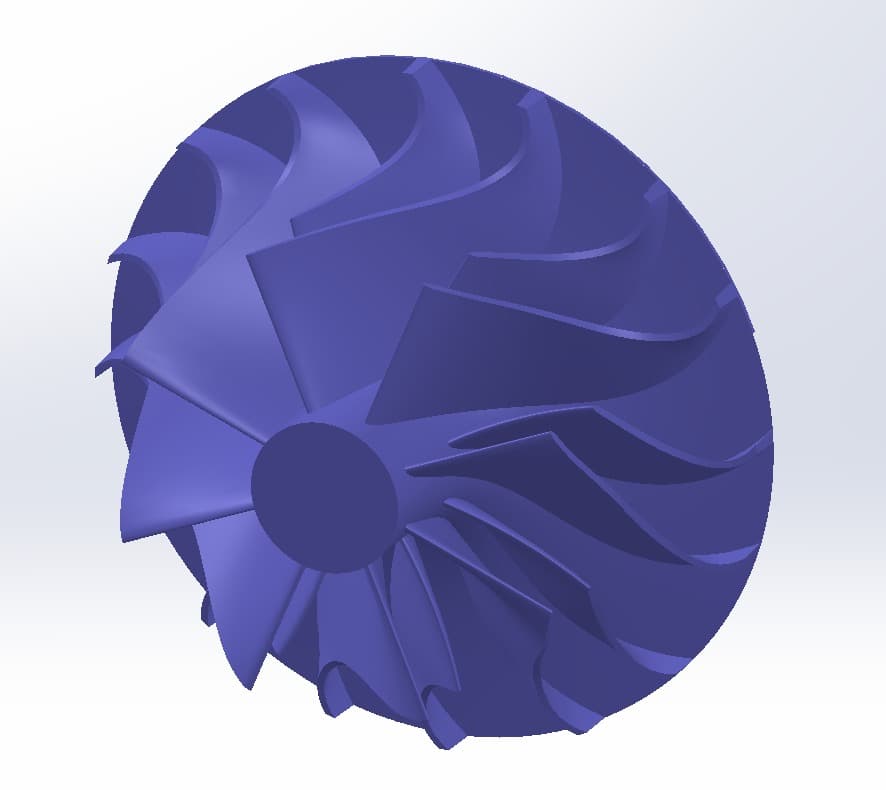
Modini's micro gas turbine was designed to produce 50 kg of thrust. The hardware was built and could be spun up to 13,500 rpm with an external starter motor, but as soon as the starter disengaged, the speed fell to 6,500 rpm and the engine shut down: it could not make the transition to self-sustained combustion.
We ran a detailed CFD analysis of the compressor, combustion chamber and turbine to find the root cause, and to deliver a design that sustains combustion above 11,000 rpm and reaches the 50 kg thrust target at full load.
The challenge
The engine could not hold enough energy to keep running by itself. Early signs pointed to an imbalance between the work the turbine produced and the work the compressor needed, particularly in the mid-speed range, while the original compressor showed signs of stall at low speed and too little pressure rise across its operating band. Specifically:
Power balance across the speed range
We evaluated the engine at three key speeds, idle (18,000 rpm), mid (50,000 rpm) and maximum (85,000 rpm), comparing the power the compressor needs with the power the turbine delivers:
| Speed | Net power | Compressor, turbine and thrust |
|---|---|---|
| 18,000 rpm (idle) | +8.5 kW | Compressor needs 7.5 kW, turbine gives 16 kW: barely self-sustaining, 105 N of thrust |
| 50,000 rpm (mid) | +210 kW | Compressor needs 130 kW, turbine gives 340 kW, 360 N of thrust |
| 85,000 rpm (max) | +540 kW | Compressor needs 510 kW, turbine gives 1,050 kW, 596 N of thrust |
The turbine had enough capacity at every speed, but at idle the margin was only 8.5 kW. The bottleneck was the compressor: it could not deliver the airflow and pressure the engine needed at low and mid speeds, above all in the transition off the starter.
Compressor redesign
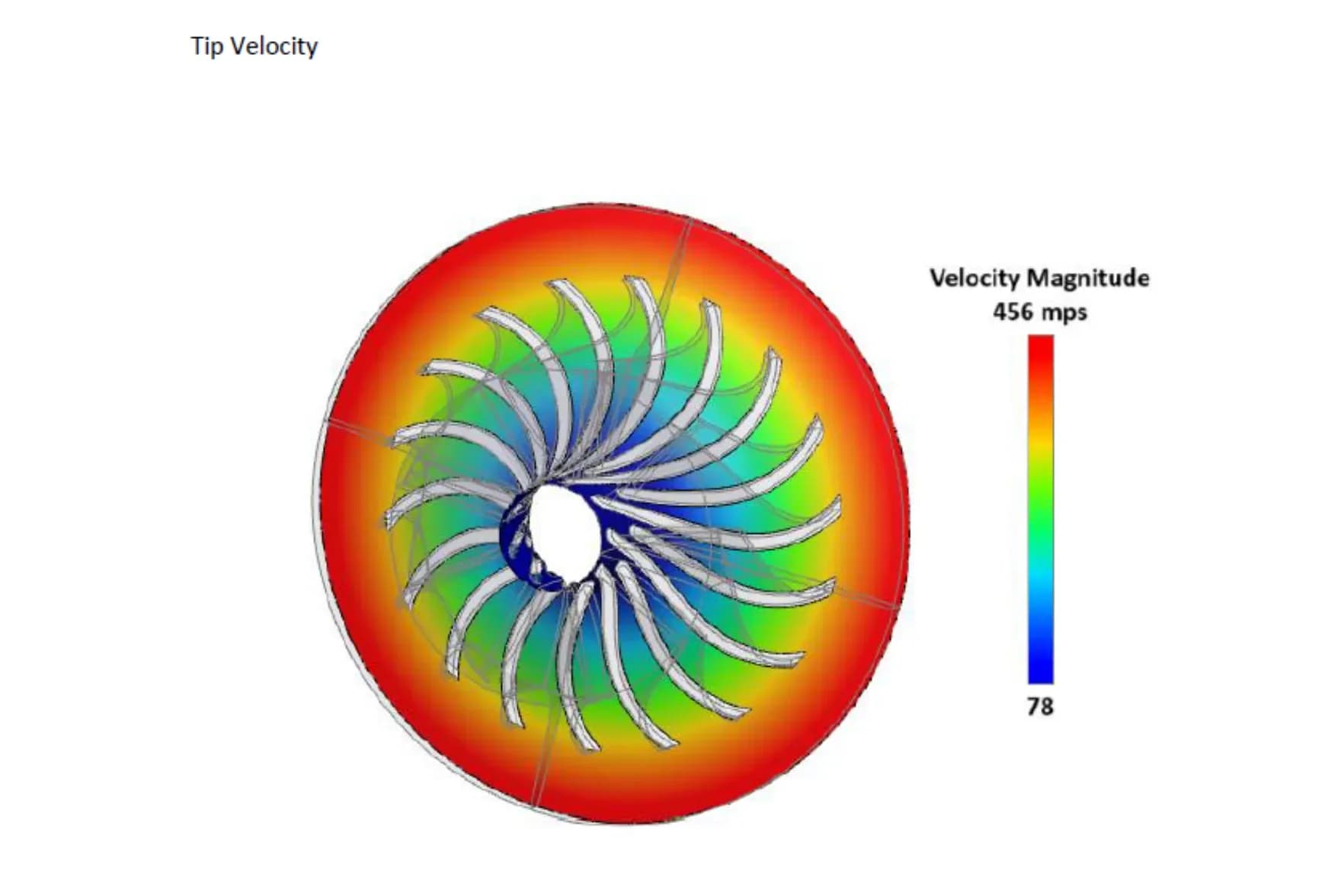
To eliminate the stall and build more pressure, we redesigned the compressor geometry completely. The CFD compares the two designs at 50,000 rpm:
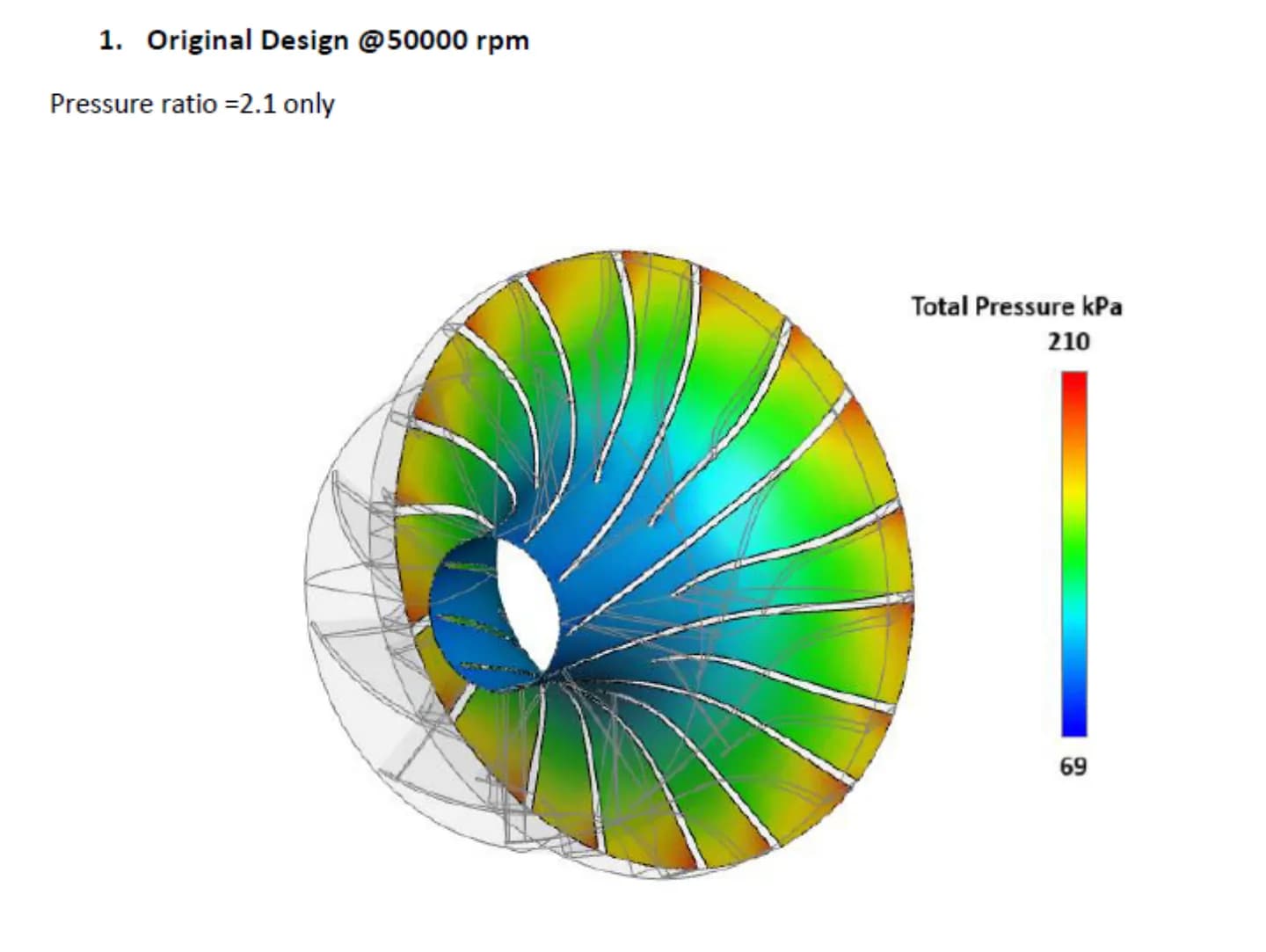
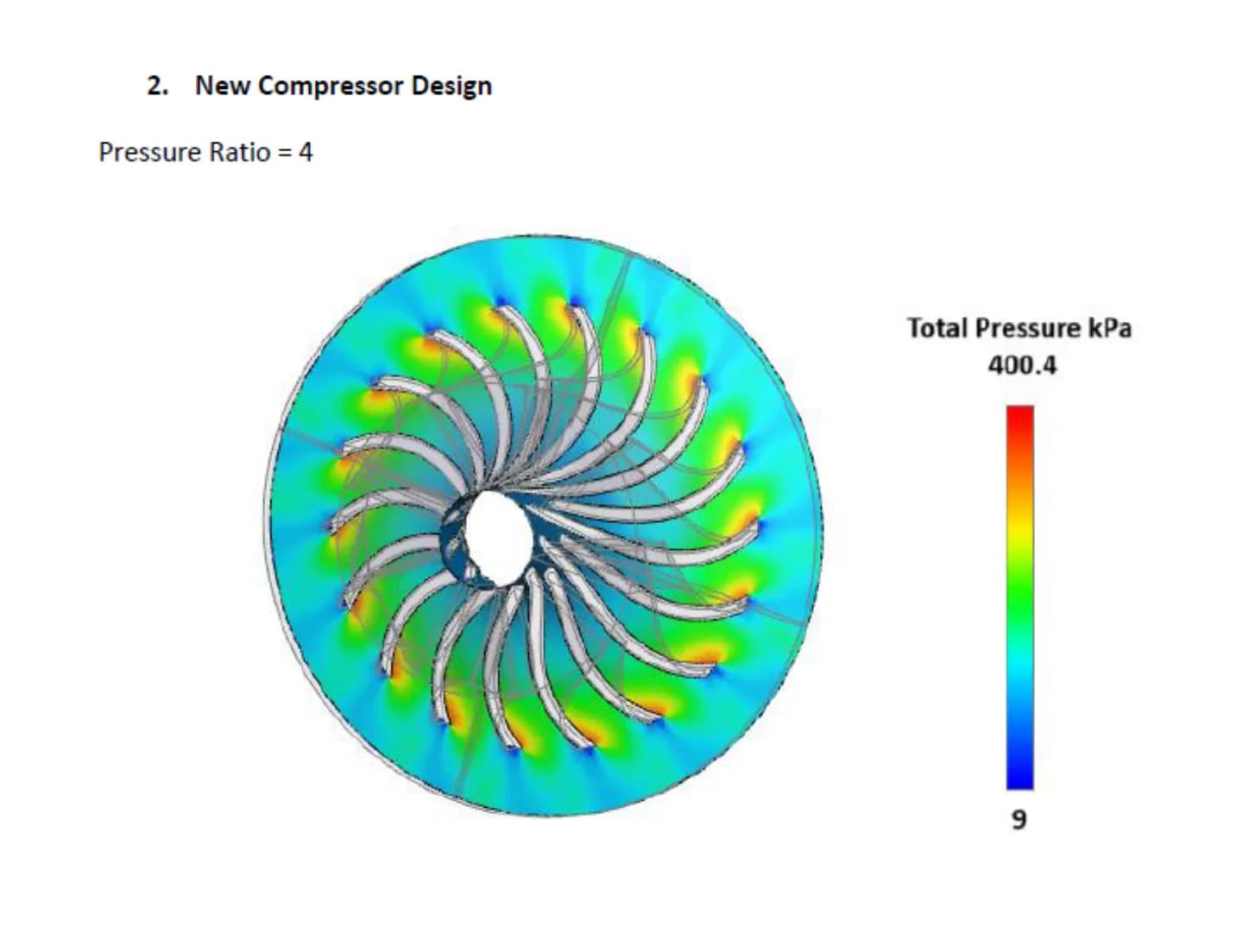
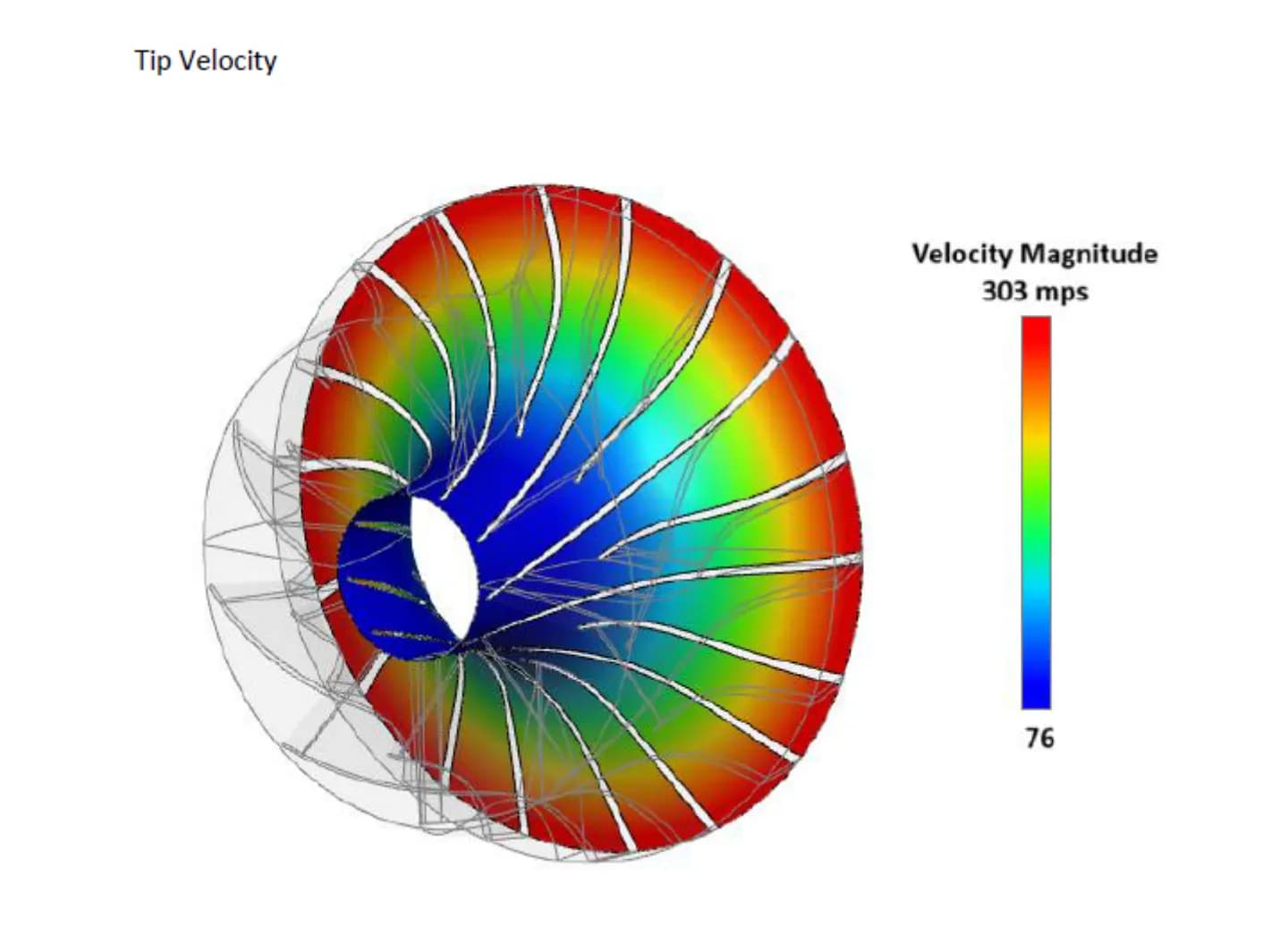
Nearly double the pressure rise at the same speed.

Results
With the redesigned compressor, the engine now:
50 kg of thrust is about 490 N.
Conclusion
Simulation-driven redesign resolved the combustion problem by fixing its real cause: the mismatch between the turbine's power and the compressor's pressure rise. The new compressor eliminated the stall, raised the pressure ratio and kept the airflow consistent across the speed range, so the engine now moves smoothly from assisted start-up to self-sustained running, a critical milestone for any micro gas turbine. The next steps are thermal optimisation and mechanical durability studies, ahead of integrated testing. For the same CFD applied to high-speed exhaust flow, see our converging-diverging nozzle study.
Frequently asked questions
Why would a micro gas turbine fail to sustain combustion?
If the compressor cannot deliver enough airflow and pressure at low speed, the turbine cannot drive it once the starter disengages, so the engine slows down and shuts off. Here the original compressor stalled at 18,000 rpm and reached a pressure ratio of only 2.1 at 50,000 rpm.
How did CFD find and fix the problem?
CFD of the compressor, combustion chamber and turbine, with a power balance at 18,000, 50,000 and 85,000 rpm, showed that the turbine had enough capacity and pinpointed the compressor. The redesign raised the pressure ratio to 4.0, removed the stall and gave a clear characteristic curve at 18,000 rpm.
What thrust does the redesigned engine reach?
A predicted 360 N at 50,000 rpm and 596 N at 85,000 rpm, above the 50 kg (about 490 N) design target.
What is compressor stall?
Stall is flow separation on the compressor blades when the compressor cannot push enough air against the pressure it is building. The pressure rise collapses and, at its worst, the flow surges. On a compressor map it shows as a speed line with no usable characteristic, as on the original design at 18,000 rpm.