
About the client
Bony Polymers is a manufacturer of precision rubber-to-metal bonded parts in India. They came to us to improve a critical component: a side bumper for a train, in which rubber bonded to metal plates takes and cushions repeated loads in service.
The brief had two targets: raise the bumper's static stiffness to 0.7 kN/mm over a deflection of 5 to 10 mm, and make sure it survives at least 600,000 load cycles. Our job was to use finite element analysis (FEA) with accurate rubber material modelling to evaluate, refine and validate a design that meets both.
The challenge
The first version of the bumper was not stiff enough, and its fatigue behaviour was unclear. The geometry and materials were broadly in place, but nobody could say whether the part would give the required response within its allowed deflection, or survive long-term cyclic loading. The specific challenges were:
Meeting them called for hyperelastic material modelling, fatigue simulation and load path optimisation, not a quick linear check.
Our approach
Review and correct the model
We reviewed the initial simulation and fixed its geometry set-up, applied realistic boundary conditions (a fixed face and a precisely applied load) and assigned the correct elastic modulus, 12.4 MPa, to the bottom rubber plate.
Model the rubber as hyperelastic
A linear elastic material cannot follow the non-linear response of rubber, so we used hyperelastic models built for elastomers: Neo-Hookean and Marlow.
Refine the geometry
We modified the geometry to spread the stress more evenly and reduce the peak strain zones, iterating until the stiffness target was met.
Check stiffness, load range and fatigue
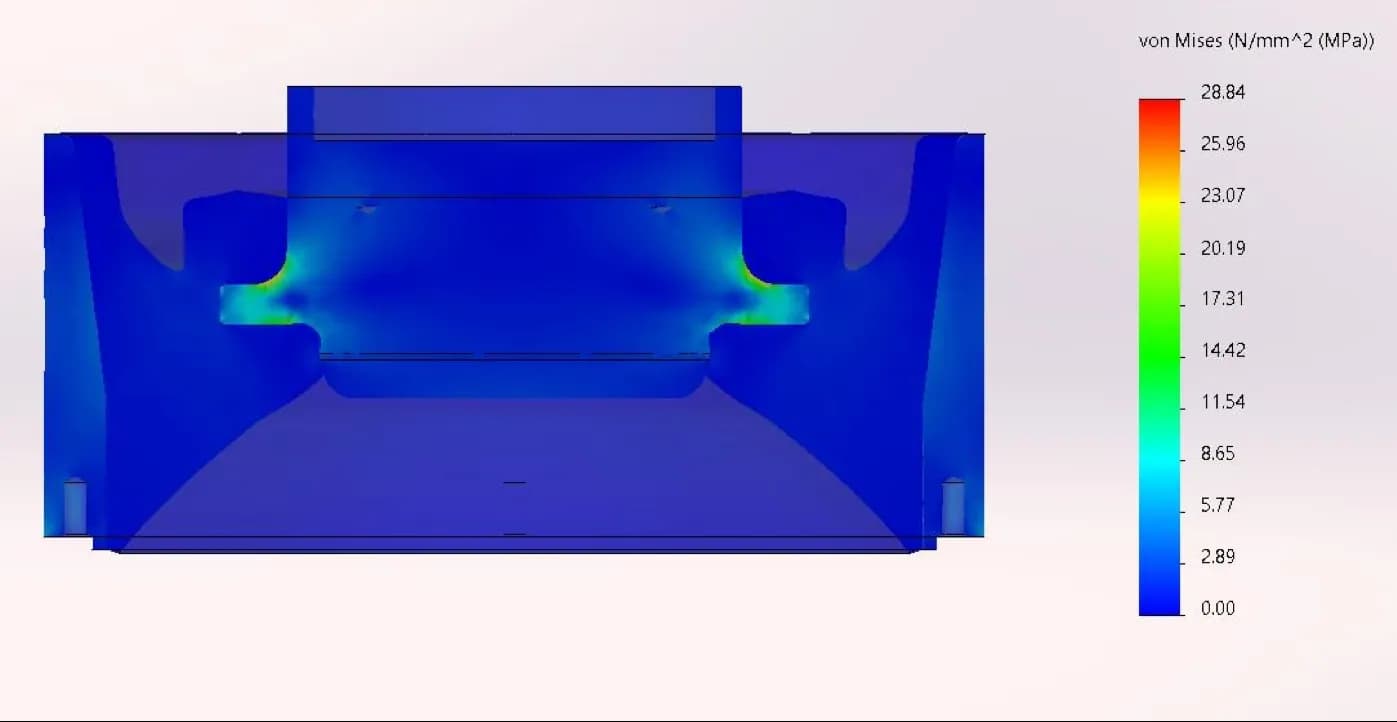
We confirmed the stiffness, extended the load to 18 kN, then ran a fatigue analysis at 18 kN, a conservative estimate of the service load.
Stiffness: 0.7 kN/mm, on target
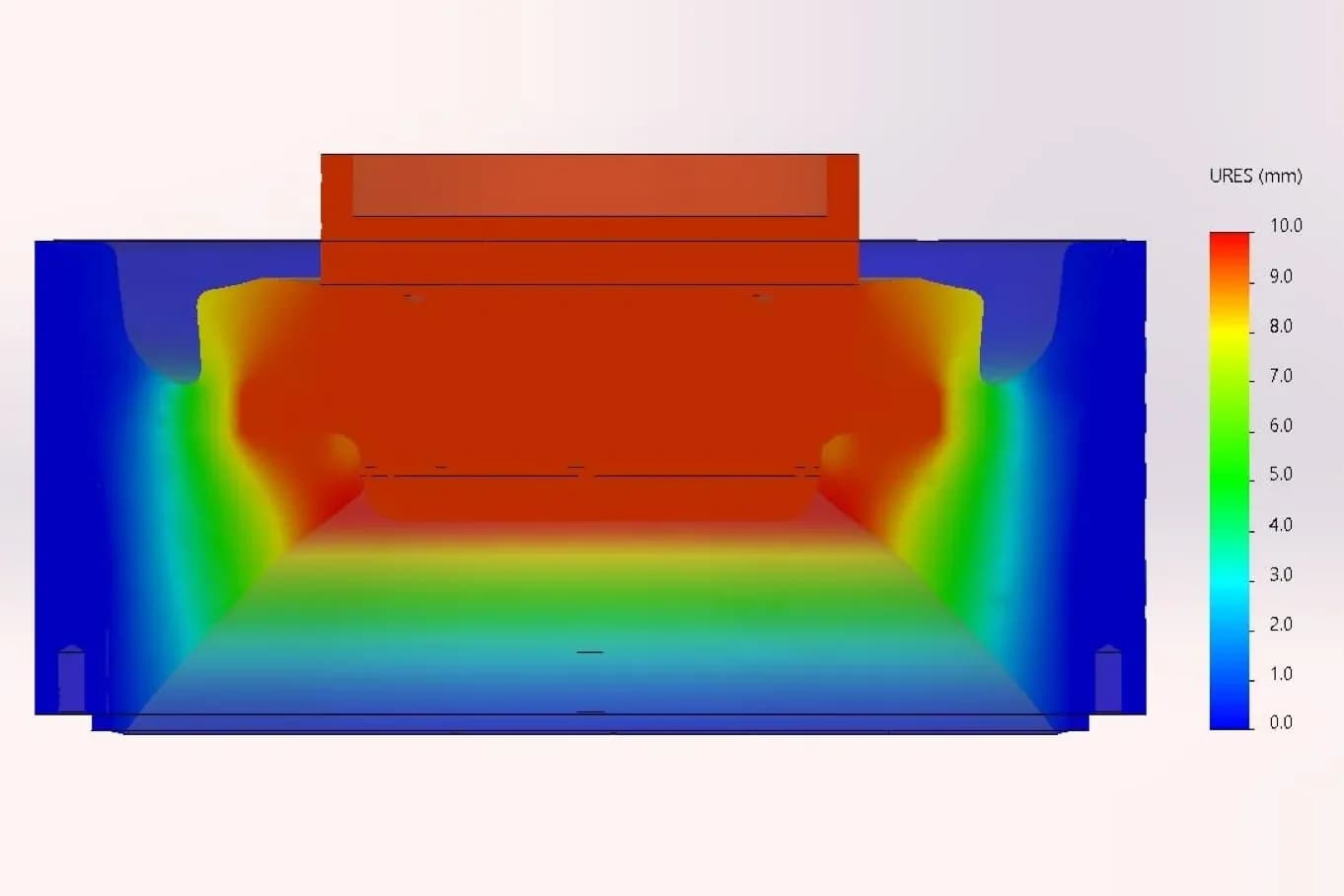
Across several FEA iterations, the decisive result came when a 7 kN force produced exactly 10 mm of deflection, as the displacement plot at the top of this page shows. We then pushed the load further to check the bumper well beyond that point:
| Check | Result | What it means |
|---|---|---|
| Stiffness | 7 kN / 10 mm = 0.7 kN/mm | Exactly the client's target, within the 5 to 10 mm range |
| Load range | Up to 18 kN | Deformation stays within safe limits, with no region overstressed |
Fatigue life beyond 600,000 cycles
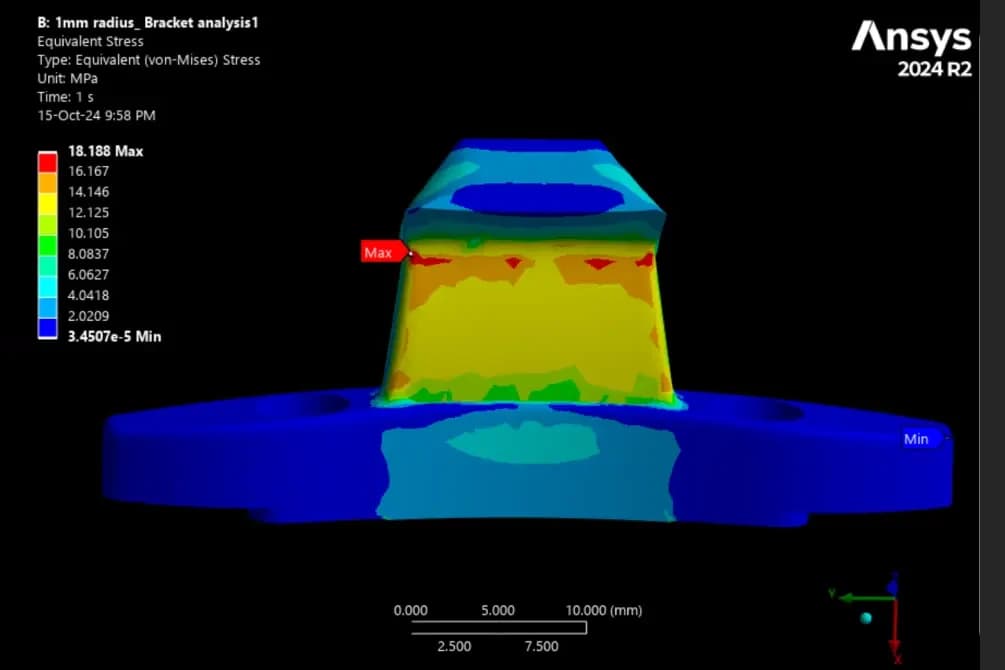
The fatigue analysis used a load of 18 kN, a conservative estimate of the stress the bumper sees in operation. It mapped the life across the whole part:
| Region | Fatigue life | Assessment |
|---|---|---|
| Load-bearing rubber | Over 600,000 cycles | Meets the requirement |
| Bottom plate edges | About 170,000 cycles | Local damping zones, not load paths, so the bumper's function is not affected |
Mapping the life across the part shows exactly where the margins are: the structural rubber clears the target, and the only lower-life areas are damping zones, whose role does not depend on them reaching it.
Results and approval
The project delivered a robust, validated design that:
We delivered the full set of results: stress and deformation plots at several load levels, fatigue life maps, force–deflection graphs and the stiffness curve confirming the targets. Bony Polymers reviewed the report and approved the final design for production. Because the hyperelastic model made the predictions far more reliable, fewer physical prototypes were needed, and the design reached approval faster.
Frequently asked questions
Why use hyperelastic material models for rubber parts?
Rubber is non-linear: its stiffness changes as it deforms, and it works at large strains. A linear elastic model misjudges the stiffness, so hyperelastic models such as Neo-Hookean and Marlow are used to follow the real stress–strain curve, giving force–deflection predictions that match the part.
How was the 0.7 kN/mm stiffness confirmed?
In the FEA, a 7 kN load produced exactly 10 mm of deflection. 7 kN divided by 10 mm is 0.7 kN/mm, the client's target, within the required 5 to 10 mm range.
Can FEA predict the fatigue life of rubber-to-metal bonded parts?
Yes. Here the fatigue analysis at 18 kN showed the load-bearing rubber lasting beyond 600,000 cycles, with lower lives (about 170,000 cycles) only at the bottom plate edges, which act as damping zones rather than load paths.
Did the bumper design go into production?
Yes. Bony Polymers reviewed the full report, with the stress, deformation, stiffness and fatigue results, and approved the final design for production use.