
Home / Projects / Structural Strength Analysis of a 6-DOF Robotic Drilling Arm and Its Joints
Structural Strength Analysis of a 6-DOF Robotic Drilling Arm and Its Joints
A robotic drilling arm has to be strong in two ways at once. It has to carry the drilling load without the structure yielding, and it has to hold that load without flexing so much that the drill wanders off target. This project put a complete 6-DOF robotic drilling arm, including the joints and bolts that tie it together, through a structural FEA in SolidWorks Simulation to check exactly that: how strong the arm is, and how much it moves, when the drilling torque is applied.
The important part is that the whole assembly was analysed, not just a single clean part. Joints and bolted connections are usually where a structure is weakest and where stress concentrates, so testing the full assembly is what makes the result trustworthy. The analysis produced the stress across the arm, the deflection at the tool end, and a clear factor of safety against the material yield strength.
Project Details
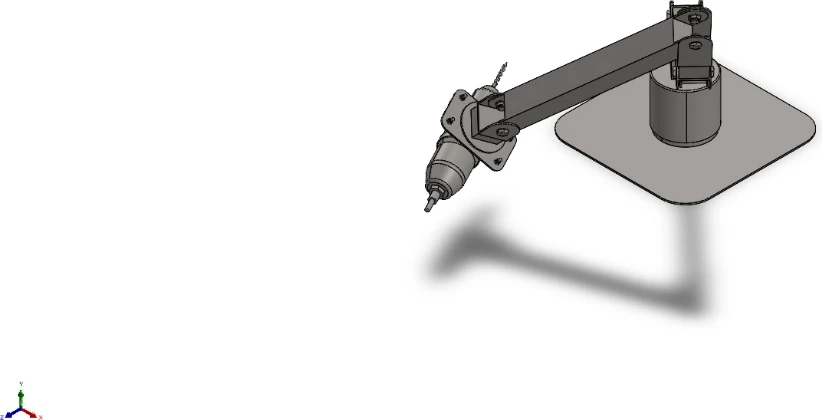
The model is a full 6-DOF (six degrees of freedom) robotic arm built for drilling, analysed as a complete assembly with its links, joints, and bolted connections in place. The key details were:
- Model: the complete FINAL ASSEMBLY of the 6-DOF robotic drilling arm, including the joints and bolts that hold the links together.
- Material: AISI 1020 steel throughout, with a yield strength of about 351.6 MPa and a density of roughly 7,900 kg per cubic metre.
- Analysis type: a static structural study in SolidWorks Simulation, which is the right choice for a strength and stiffness check under a steady load.
- Focus: the strength of the arm and its joints under the load applied during drilling.
Objective and Approach
The objective was to confirm that the arm and its joints can carry the drilling load safely, and to find out how much the arm deflects while doing so. The approach was a static FEA with the loads and constraints set to represent the arm in service:
- Fixture: the base was fully fixed with a fixed geometry constraint, holding the arm the way it is anchored in reality.
- Load: a drilling torque of 200 N.m applied across the working faces, representing the reaction the arm feels while drilling.
- Mesh: a solid mesh across the full assembly with mesh controls to resolve the joints and bolted regions where stress concentrates.
- Outputs: von Mises stress, resultant displacement, and equivalent strain, read together to judge both strength and stiffness.
Applying the torque across the assembly, rather than to one idealised part, is what lets the joints and bolts carry the load in the simulation the same way they do on the real arm, so the stress that shows up at those connections is meaningful rather than hidden.
Simulation and Results
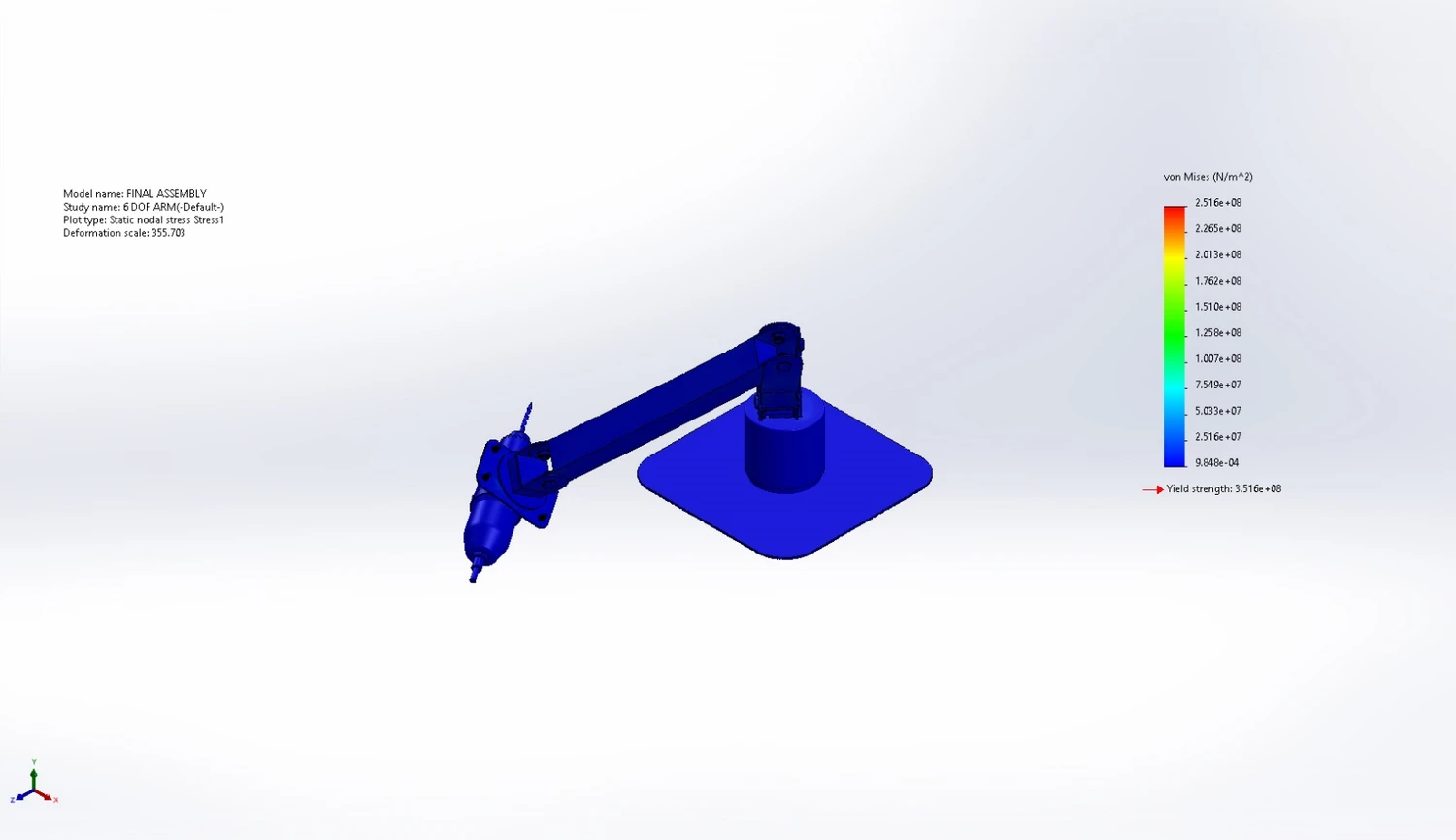
The results show an arm that comfortably survives the drilling load. The peak von Mises stress reached about 251.6 MPa, sitting in a localised spot while the majority of the structure stayed at far lower stress. Against the AISI 1020 yield strength of 351.6 MPa, that peak gives a factor of safety of roughly 1.4, so the arm stays below yielding with a real margin in hand.
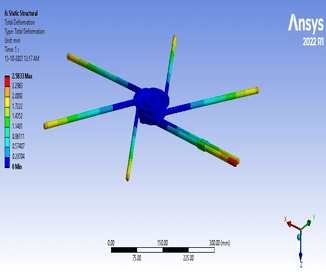
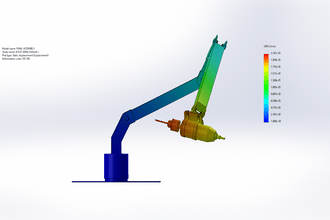
The von Mises stress plot shows where that peak lives. Most of the arm is a calm low-stress blue, and the high stress is concentrated at a specific joint region, which is exactly where you would expect a bolted, articulated structure to work hardest. Knowing precisely where the highest stress sits is what makes the result useful, because that is the spot to watch or reinforce.
Reaction at the fixed base came out to a resultant of about 472.3 N, which balances the applied drilling load and confirms the model is properly constrained and in equilibrium.
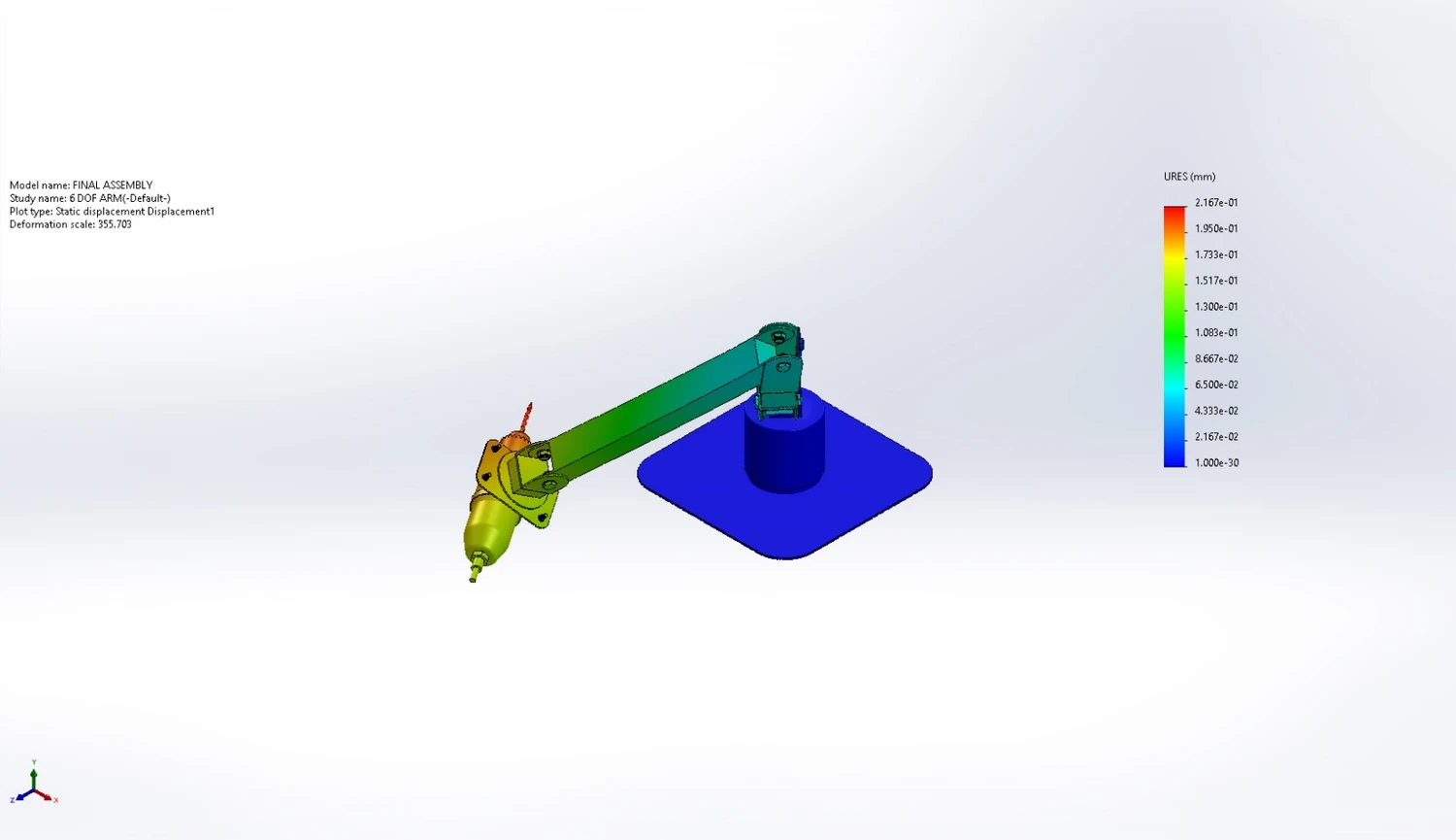
Stiffness is the other half of the picture, and here the arm performs very well. The maximum resultant displacement was only about 0.217 mm, found at the tool end furthest from the fixed base, which is a tiny movement for a structure of this size. The equivalent strain stayed correspondingly low, with a peak of about 6.0e-04.
For a drilling arm, that small deflection matters as much as the stress. A stiff arm keeps the drill where it is aimed, so a maximum movement of roughly two tenths of a millimetre under full torque is a strong result for accuracy.
Recommendation and Conclusion
The conclusion is that the 6-DOF robotic drilling arm, joints and all, is strong enough for the 200 N.m drilling load. It stays below the yield strength of its AISI 1020 steel with a factor of safety of about 1.4, and it is stiff enough to hold the drill on target with only about 0.217 mm of deflection. As a strength check, the design passes.
A few recommendations follow naturally from the results:
- A factor of safety near 1.4 is acceptable, but it is a modest margin. If the arm may see higher loads, shock loading, or harder drilling, reinforcing the highest-stress joint would build in more headroom.
- Because drilling is repetitive, a fatigue check on that peak-stress region is worth doing, since a stress that is safe for a single load can still matter over many thousands of cycles.
- With the arm proven strong, there is room to trim weight away from the low-stress areas, which make up most of the structure, without losing the safety margin.
Structural FEA at Solvo Engineers
Whether a structure holds up under load is rarely obvious by eye, especially once joints, bolts, and articulated links are involved. FEA answers it directly, showing the stress, the deflection, and the factor of safety, and pointing to the exact spot that works hardest, so a design can be signed off or improved on evidence rather than guesswork. Testing a full assembly, joints included, as we did here, is what turns a strength check into something you can rely on.
At Solvo Engineers we run structural FEA in SolidWorks Simulation and Ansys for machines, robotic arms, frames, and bolted assemblies, covering stress, deflection, factor of safety, and fatigue, alongside our wider FEA and CFD consulting work. If you have a structure or a mechanism you need proven strong before it is built, our team can help. Reach out through our contact page and talk it through with a structural engineer.
Our Projects
See how Solvo Engineers has helped its clients achieve their vision of digital innovation.
Our Technologies
 Contact Us
Get in touch with us