
Home / Projects / Laser Heat Source Simulation on a Plate Using Transient Thermal Analysis
Laser Heat Source Simulation on a Plate Using Transient Thermal Analysis
This project simulates a laser acting as a concentrated heat source on a plate, solved as a transient thermal analysis in Ansys. A laser puts a lot of energy into a very small spot, and the plate has to carry that heat away, so the simulation follows how the temperature builds under the beam and how the heat spreads through the material over time.
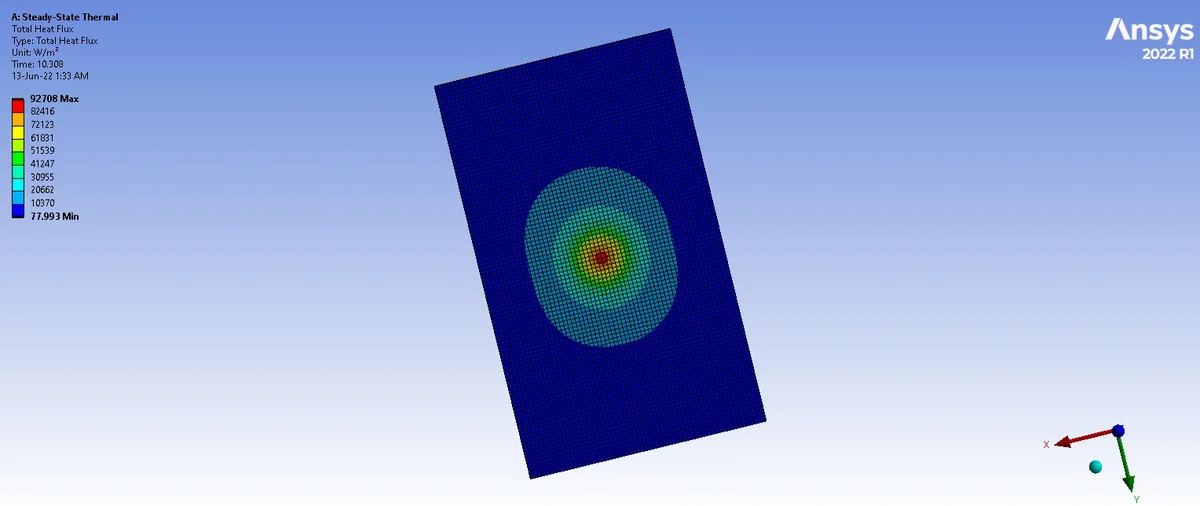

Two results tell the story: the temperature distribution, which shows how hot the plate gets and where, and the total heat flux, which shows how the heat energy actually moves through the plate. Watching both change through time shows the plate heating up under the laser and conducting that heat outward.
Objectives
The aim was to capture how a plate responds to a laser as a heat source, through time rather than at a single instant. The objectives were:
- Model a laser as a concentrated heat source applied to a plate.
- Solve the heating as a transient thermal analysis so the results evolve in time.
- Capture the temperature distribution across the plate as it heats.
- Capture the total heat flux to see how the heat moves through the material.
Setup
The plate was set up for a transient thermal analysis, with the laser applied as a concentrated heat input on the surface and the rest of the plate free to conduct and shed heat. Solving it as transient rather than steady state is the point here, because what matters is how the temperature and the heat flux build and move as time passes, not just the final state.
Temperature Distribution
The temperature result shows the plate heating under the laser. A sharp hot spot forms right where the beam lands, and as time goes on the heat spreads out into the surrounding material, with the temperature falling off with distance from the source.
The animation makes it easy to see how quickly the peak temperature builds and how far the heat reaches into the plate.
Total Heat Flux Distribution
Total heat flux shows how the heat energy moves through the plate, rather than how hot it is. The flux is highest around the laser spot, where the temperature gradients are steepest, and it points outward as heat is driven from the hot region into the cooler material.
The animation shows this flux pattern developing as the plate heats, which is what tells you how effectively the material is carrying the laser's energy away.
Conclusion
Together the two results give a full read on the laser heating: the temperature distribution shows how hot the plate gets and where, and the total heat flux shows how that heat travels through the material. Solving it as a transient analysis captures the whole build-up rather than a single snapshot, which is what you need for anything involving a laser or another concentrated heat source, from welding and cutting to heat treatment.
Thermal and Transient Heat Transfer Simulation at Solvo Engineers
Concentrated heat sources like lasers are hard to judge by hand, because the temperature and the heat flux change fast and vary sharply across the part. Transient thermal simulation shows exactly how the heat builds and moves, so a process can be understood and tuned before any material is put under the beam.
At Solvo Engineers we run thermal and transient thermal simulation in Ansys for laser and welding heat sources, electronics, heat sinks, and general heat transfer, covering temperature, heat flux, and thermal gradients. If you have a heating or cooling problem and need to see how the heat behaves, our team can help. Reach out through our contact page and talk it through with a simulation engineer.
Related articles
Our Projects
See how Solvo Engineers has helped its clients achieve their vision of digital innovation.
Our Technologies
 Contact Us
Get in touch with us