
Heat Sink Design and Electronics Cooling with CFD: Keep Your Product Cool and Reliable

Introduction
Heat is one of the most common reasons electronic products fail early, slow down or feel too hot to hold. Chargers, routers, LED lights, power tools, audio equipment and smart home devices all turn some of their power into heat, and that heat has to go somewhere.
When cooling is left until late in development, the fixes are painful: a bigger enclosure, a noisy fan, a costly heat sink or a redesign after the mould is cut. Computational Fluid Dynamics (CFD) lets you design the heat sink, vents and airflow on screen first. This guide explains how heat leaves a product, what a thermal simulation shows and the mistakes that cause most overheating problems.
Why Thermal Design Matters
- Reliability: a common rule of thumb is that the life of many electronic components roughly halves for every 10 °C rise in temperature.
- Performance: processors, LEDs and power electronics reduce their output or shut down when they get too hot.
- Safety: product safety standards such as IEC 62368-1 limit how hot the surfaces people touch may get.
- Size, noise and cost: good thermal design lets you use a smaller heat sink, a slower fan or no fan at all.
How Heat Leaves a Product
Heat travels from each component to the outside air through a chain of resistances: from the chip to its case, through the thermal interface material (pad, paste or gap filler), into the heat sink or enclosure, and finally into the air. Each link adds temperature, and the weakest one decides how hot the component runs.
- Conduction through copper layers, heat spreaders, the heat sink base and the enclosure walls.
- Convection to the air, either natural (warm air rising on its own) or forced by a fan. Heat transfer coefficients are roughly 5 to 10 W/m²K for natural convection and 20 to 100 W/m²K or more with a fan.
- Radiation from hot surfaces, which matters most in fanless products. Anodised or painted surfaces radiate far better than bare, shiny metal.
Heat Sink Design: What CFD Optimises
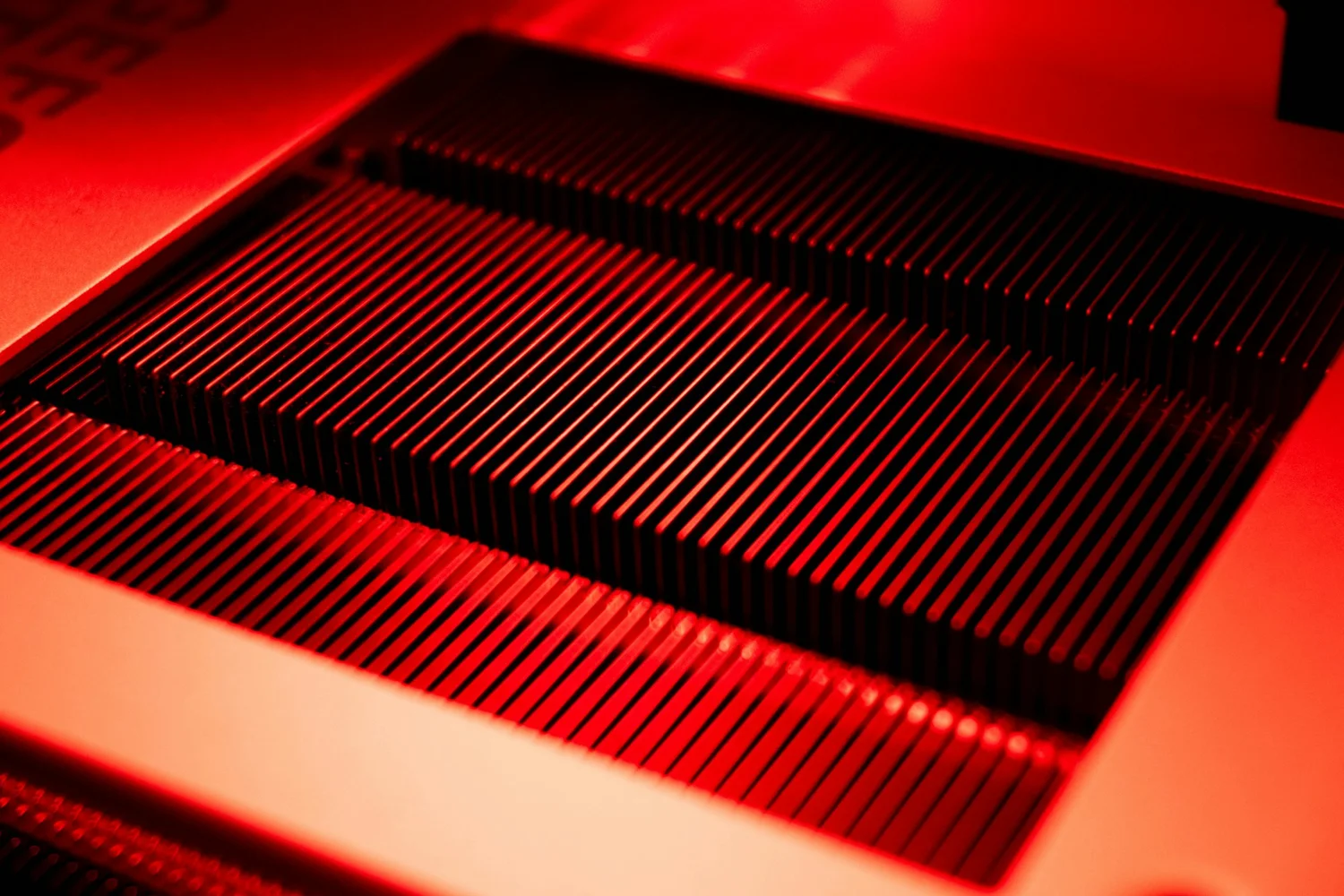
- Fin spacing: more fins add surface area, but fins that are too close choke the airflow. The best spacing is wider for natural convection than with a fan.
- Fin height, thickness and base thickness: tall, thin fins lose effectiveness towards the tip, and a thin base cannot spread heat from a small hot chip.
- Orientation: for natural convection, fins should run vertically so warm air can rise through them.
- Material: aluminium alloys such as 6063 conduct around 200 W/mK and are light and easy to extrude; copper conducts almost twice as well but is heavier and costlier.
- Heat pipes and vapour chambers spread heat from a concentrated source across a larger fin area.
CFD compares these options side by side, so you choose the smallest, cheapest heat sink that keeps every component within its limits.
Enclosures, Vents and Fans
- Vent placement: inlets low and outlets high use the chimney effect. Inlets and outlets too close together let hot air short-circuit straight back in.
- Fan selection: a fan delivers its rated flow only with nothing in the way. CFD finds the real operating point, where the fan curve meets the resistance of the enclosure, filters and grilles.
- Component layout: hot components downstream of other hot components breathe pre-heated air.
- Sealed enclosures: IP-rated products have no airflow inside, so heat must be conducted to the walls and shed from the outside surface.
Our CFD airflow analysis of a fan heater traced the air from inlet to outlet through a consumer heating product, and our CFD analysis of a cooling duct shows how internal geometry controls the flow and pressure loss that every fan has to overcome.
What a Thermal CFD Study Shows
- The temperature of every component, compared with the limits in its datasheet.
- Hot spots, and the airflow paths that cause them.
- Surface temperatures people can touch, compared with safety limits.
- The fan operating point and the air speed through each part.
- Side-by-side results for design options, such as two heat sinks or two vent layouts.
The study uses conjugate heat transfer, solving the airflow and the heat conduction in solids together, at the worst realistic conditions: the highest ambient temperature, the product's mounting orientation and, for equipment used at altitude, thinner air that cools less. Products that warm up over minutes, such as chargers and power tools, need a transient analysis like our transient thermal analysis of a plate under a laser heat source, which shows how temperatures build over time.
Natural Convection or a Fan?
Fanless designs are silent, dust-tolerant and have one less part to fail, but they need more surface area and careful layout. A fan moves several times more heat from the same heat sink, at the cost of noise, power, dust and a moving part that can wear out. CFD shows whether a fanless design can work before you commit to either.
The same methods scale up to rooms and cabinets: our HVAC airflow analysis of an office container mapped air distribution and temperature through a whole space.
Common Thermal Design Mistakes
- Fins packed too tightly for a fanless product.
- Inlet and outlet vents next to each other.
- Designing at room temperature instead of the worst ambient.
- Ignoring the thermal interface material between chip and heat sink.
- Sealing an enclosure without a conduction path to its walls.
- Choosing a fan by its free-air rating instead of its real operating point.
What We Need to Start
- 3D CAD of the enclosure, boards and heat sink, or drawings for our 3D CAD team to model.
- The power each main component dissipates.
- Maximum allowed temperatures from the component datasheets.
- Ambient conditions, mounting orientation and any fan or filter data.
- Materials and thermal interface specifications.
Frequently Asked Questions
How hot is too hot for electronics?
It depends on each component: the limits are in its datasheet. Good designs keep a margin below those limits at the worst ambient temperature, rather than running right at them.
Can CFD replace thermal testing?
No, but it means far fewer test rounds. We size the design with CFD, and a final test with thermocouples or a thermal camera confirms it.
Does my product need a fan?
Not always. A thermal simulation shows whether natural convection and a well-designed heat sink are enough at your power and ambient temperature.
Can you improve an existing product that overheats?
Yes. We model the current design, find what limits the cooling and test fixes such as new vents, a different heat sink or a better fan before you change the hardware.
How do we get a quote?
Send your CAD files and component power data through our contact page. We will reply with a scope, timeline and quote.
Keep Your Product Cool Before You Tool It
From heat sink sizing to vent layout and fan selection, our engineers can show you how hot your product will run and what to change, before you build prototypes or cut a mould. Send us your CAD files and power data, and we will reply with a clear scope and quote.