Plastic Part Design for Injection Molding: How FEA Gets Strength, Stiffness and Material Right

Introduction
Injection molding makes plastic parts cheap, fast and repeatable, but only after a large up-front investment in the mould. Production moulds take weeks to make and are expensive to change, so a plastic part that is too weak, too floppy or warps out of shape is a costly discovery once the steel is cut.
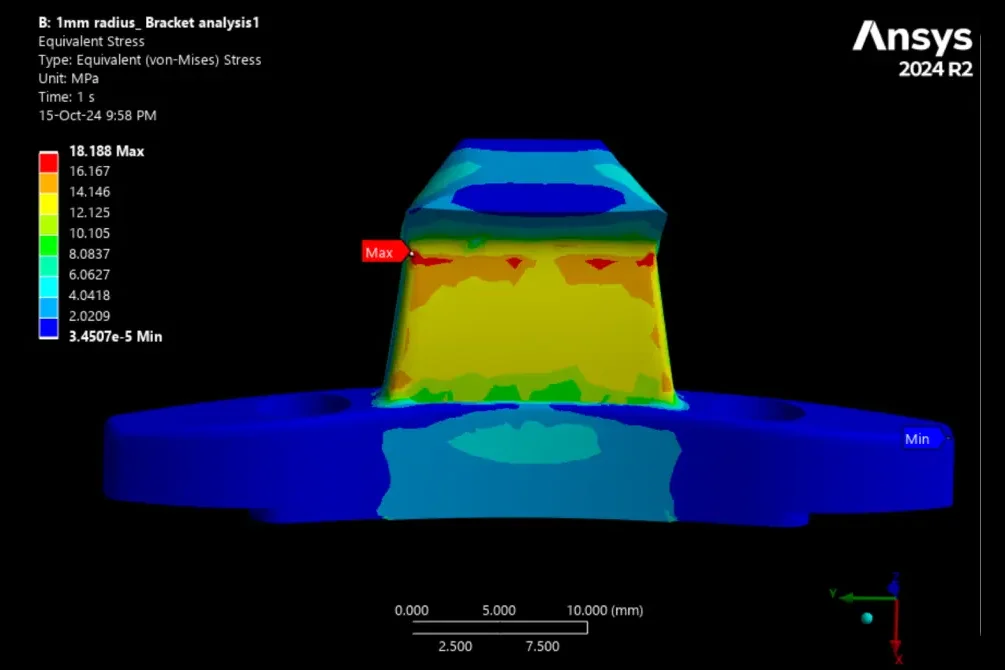
This guide covers the design rules that make plastic parts mouldable and strong, how to choose the material, and the Finite Element Analysis (FEA) checks that confirm a design before tooling. The cover image is from our own Ansys analysis of an injection-moulded nylon bracket.
Wall Thickness: Keep It Uniform
- Uniform walls cool evenly, which reduces sink marks, voids and warpage. Many consumer parts sit around 1 to 3 mm.
- Thick sections cool slowly, lengthen the cycle time and cost more material, so it is better to core them out.
- Where thickness must change, blend it gradually instead of with a step.
Ribs, Bosses and Gussets
Ribs add stiffness without thick walls. Common guidelines are:
- Rib thickness around half to two-thirds of the wall it sits on, to avoid sink marks on the other side.
- Rib height up to about three times the wall thickness.
- A radius where the rib meets the wall, and draft on its sides.
- Screw bosses cored out to wall thickness and tied to nearby walls with ribs or gussets, not left standing alone.
Draft, Radii and Undercuts
- Draft: faces parallel to the mould opening need a slight taper, often 0.5° to 1° and more on textured surfaces, so the part releases cleanly.
- Radii: sharp internal corners concentrate stress and restrict flow. Generous radii make parts stronger and easier to fill.
- Undercuts: hooks, holes and grooves at an angle to the mould opening need side actions or lifters, which add cost. Clever geometry, such as a pass-through hole under a snap hook, can avoid them.
Choosing the Plastic
- PP: low cost, tough and chemically resistant, but not very stiff.
- ABS and PC/ABS: good appearance and impact strength, typical for housings.
- PC: very tough and transparent, but sensitive to some chemicals.
- PA (nylon) and POM: strong and wear-resistant; nylon absorbs moisture, which lowers its stiffness.
- Glass-filled grades: much stiffer and stronger, but more brittle and direction-dependent.
The right choice is a numbers question. In our FEA comparison of polycarbonate, PA11, PA12 and PA12CF for a polymer rod guard, PA11 deflected 2.58 mm at 8 N and polycarbonate 9.39 mm, so the analysis made the decision rather than guesswork.
What FEA Checks on a Plastic Part
- Stiffness: deflection under load, often the real limit for plastic parts.
- Strength: stress and strain compared with the material data, with a sensible safety margin.
- Stress concentrations at corners, holes and rib roots, and the effect of the fillet radius.
- Creep: plastics slowly deform under constant load, so long-term loads are checked with long-term (creep) properties rather than the short-term modulus.
- Temperature: stiffness and strength fall as plastics warm up.
- Impact and drops, covered in our guide to drop test simulation, and snap fits, covered in our guide to snap-fit design with FEA.
In our FEA of a nylon injection-moulded bracket in Ansys 2024 R2, the client needed confidence before paying for the mould. The mesh was refined around the fillets, supports and mounting hole, and the peak stress of about 18.2 MPa sat at the transition shown on this page's cover.
Fibre Orientation and Weld Lines
In glass-filled plastics the fibres line up with the flow, so the part is stiffer and stronger along the flow than across it. Weld lines, where two flow fronts meet, can be noticeably weaker. Mould filling simulation predicts both, and its fibre orientation results can be brought into the structural FEA for a more accurate answer on critical parts.
Shrinkage and Warpage
Plastic shrinks as it cools, and uneven shrinkage bends the part out of shape. Uniform walls, balanced ribs and a well-placed gate keep warpage down, and mould filling simulation predicts it. If warped parts are pulled flat during assembly, FEA checks the stresses that creates.
A Practical Workflow
- Concept design following the moulding rules above.
- FEA of stiffness, strength and critical features.
- Design-for-moulding review with your moulder.
- Mould filling simulation for warpage, weld lines and gating.
- Prototype, often 3D printed or from a soft tool, and test.
- Production tooling, with changes kept "steel safe" (made by removing steel from the mould) wherever possible.
What We Need to Start
- 3D CAD of the part and mating parts, or drawings and sketches for our 3D CAD team to model.
- The loads, supports and how the part is used.
- The plastic grade, or the candidates you are considering.
- Operating temperature, environment and design life.
Frequently Asked Questions
Which plastic is strongest?
Glass-filled nylons and similar grades are among the stiffest and strongest common moulding plastics, but they are more brittle. The best plastic is the one that meets your loads, temperature and cost, which FEA helps decide.
Can FEA predict warpage?
Warpage is predicted with mould filling simulation. FEA then checks the part's strength and the stresses from assembling warped parts.
How accurate is FEA for plastic parts?
As accurate as the material data. Using properties at the right temperature, moisture level and loading time makes the biggest difference.
Should we analyse before or after the prototype?
Before. FEA is cheapest when it shapes the design, and the prototype then confirms it instead of revealing the problems.
How do we get a quote?
Send your CAD files, loads and material through our contact page. We will reply with a scope, timeline and quote.
Check Your Plastic Part Before the Steel Is Cut
Our engineers can check the strength, stiffness and critical details of your plastic part and help you choose the right material, before you invest in the mould. Send us your CAD files and requirements, and we will reply with a clear scope and quote.