CFD and FEA in the Energy Industry: 7 Applications That Cut Risk, Cost and Downtime

Introduction
Energy equipment works harder than almost anything else in industry. Heat exchangers, pressure vessels, turbines, separators and battery systems run hot, under pressure and often around the clock for decades. When one of them is designed wrong, the cost goes far beyond a redesign: unplanned shutdowns, failed inspections, lost output and safety risks.
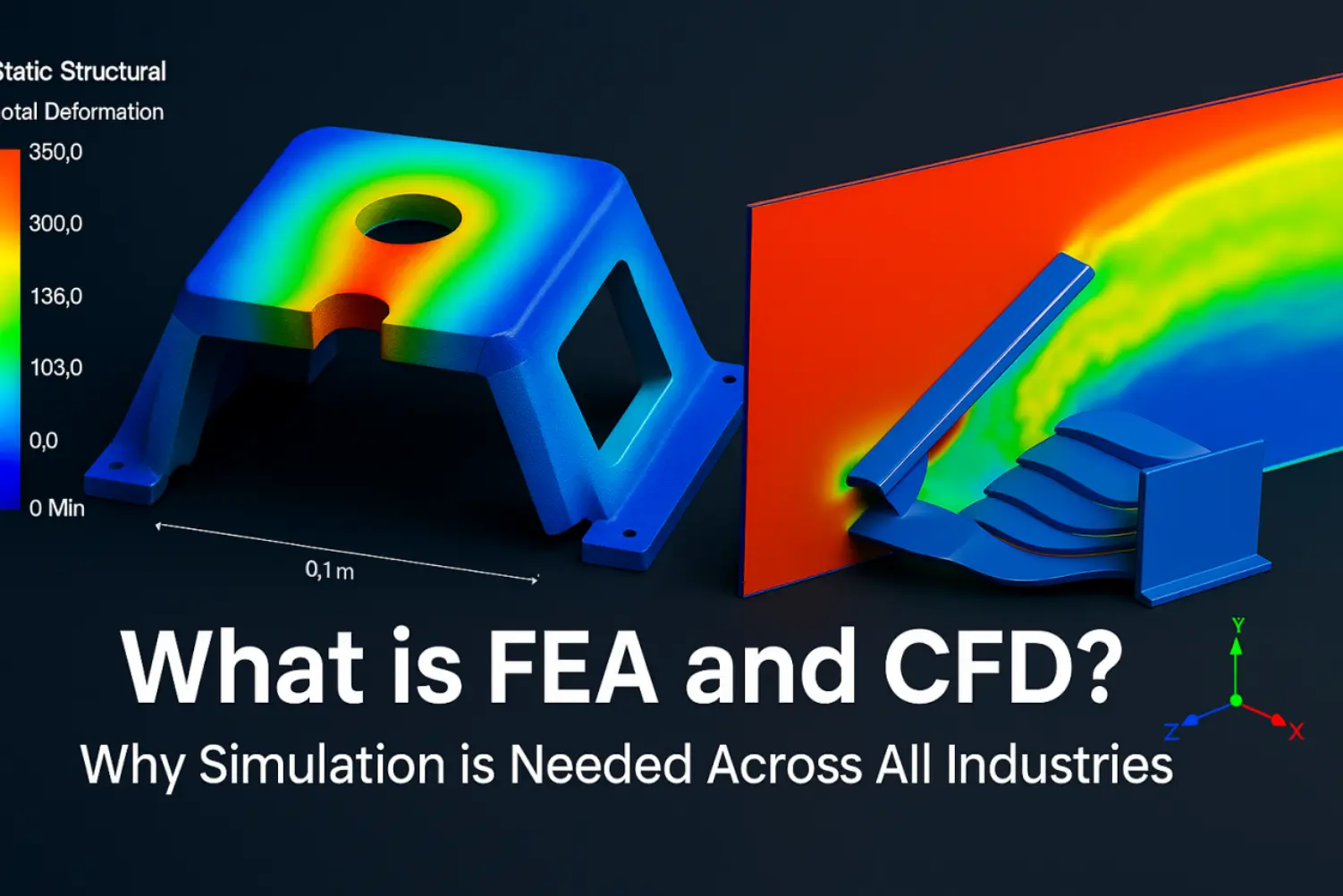
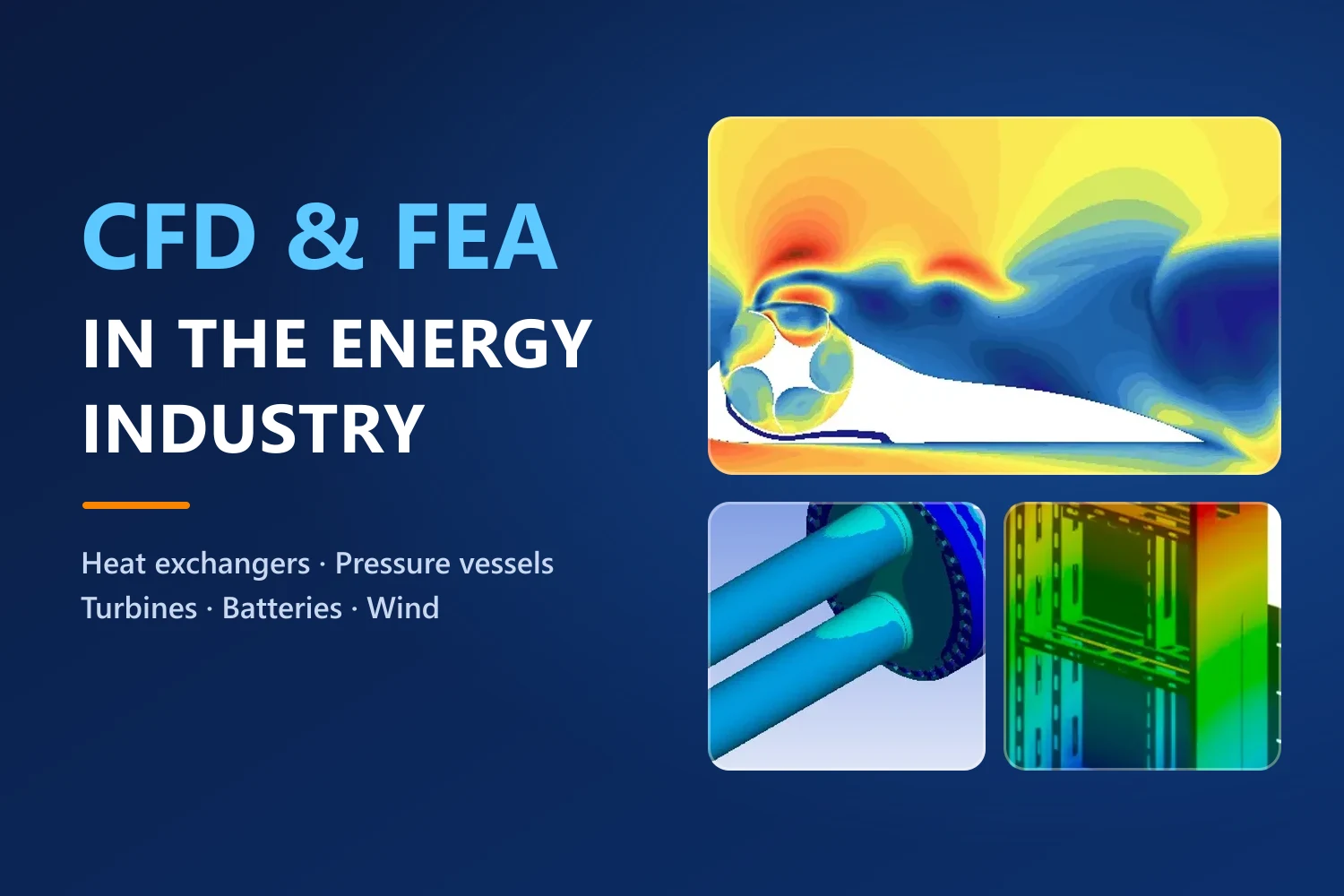
That is why more energy companies now test their equipment virtually before they build, modify or repair it. Computational Fluid Dynamics (CFD) shows how fluids and heat move through a design, and Finite Element Analysis (FEA) shows how it copes with pressure, temperature, vibration and load. Together they let engineers find problems on screen, while changes are still quick and cheap.
In this guide we walk through seven high-value applications of CFD and FEA in the energy sector, with examples from projects we have delivered, and explain exactly what you need to start a simulation study of your own.
Why Energy Companies Use CFD and FEA
Simulation pays for itself fastest where mistakes are expensive, and in the energy industry they usually are. The main benefits are:
- Fewer prototypes and site trials: compare design options virtually and only build the one that works.
- Confidence before fabrication: check stresses, deflections and temperatures against design limits and codes while changes are still cheap.
- Troubleshooting without a shutdown: find out why existing equipment underperforms, vibrates or fails, without taking it out of service.
- Higher efficiency: lower pressure drop, better heat transfer and more even flow all reduce running costs.
- Longer equipment life: predict fatigue and thermal stress, and assess damaged components before deciding to repair or replace them.
1. Heat Exchangers and Thermal Equipment
Heat exchangers sit at the heart of power plants, refineries and process facilities, and small design flaws quickly turn into lost efficiency and extra maintenance.
- CFD shows how flow spreads between tubes or plates, where it bypasses the bundle and where dead zones form that encourage fouling. It also predicts pressure drop and thermal performance before the unit is built or modified.
- FEA checks thermal stresses, tubesheets, nozzles and bolted flanges, including whether gaskets stay sealed under pressure.
Project example: we analysed the bolted flange joint of a hairpin heat exchanger in Ansys, using the real ASME materials (SA-105 flange, SA-106 Grade B pipe and SA-193 Grade B7M studs). The bolts were preloaded to about 1,350 kN before an internal pressure of 2.07 MPa was applied, so the model captured the combined stresses that decide whether the joint holds and stays sealed.
2. Pressure Vessels, Piping and Nozzles
Pressure equipment has to meet strict design codes, and its most complex areas cannot be designed with simple formulas alone.
- Design by analysis: FEA provides the detailed stresses used in the design-by-analysis route of ASME BPVC Section VIII, Division 2, for areas such as nozzles, supports, lifting lugs and local loads.
- Fatigue: repeated pressure and temperature cycles during start-ups and shutdowns can be checked for fatigue life.
- Fitness for service: when an inspection finds corrosion, dents or cracks, detailed FEA supports API 579-1/ASME FFS-1 assessments that decide whether the equipment can safely stay in service.
- Piping and nozzle loads: thermal expansion, support layouts and the loads pipes put on equipment nozzles can be checked before installation.
3. Gas Turbines, Combustion and Burners
Combustion systems combine fast-moving flow, chemistry and extreme heat, which makes them hard to get right by trial and error.
- CFD models fuel and air mixing, flame stability, temperature distribution and cooling flows, so you can see why a design runs too hot, will not light reliably or cannot keep itself running.
- FEA then checks the hot components for thermal stress and vibration.
Project example: a micro gas turbine we worked on had been assembled and could be spun up with a starter, but it could not sustain combustion on its own. Our CFD-driven design optimisation reworked the design until it achieved self-sustaining combustion above 11,000 RPM. The same combustion physics applies to power-generation turbines and industrial burners.
4. Wind Turbines and Renewable Energy
For wind and solar projects, simulation answers two questions early: how much energy will the design deliver, and will the structure survive the loads?
- CFD predicts rotor torque, speed and power output at the wind speeds your site actually sees, and shows the wake and the aerodynamic losses.
- FEA checks blades, hubs, towers and mounting structures for strength and fatigue, and modal analysis keeps natural frequencies away from the rotor's operating speeds to avoid resonance.
- Solar farms: FEA of mounting structures under wind and snow loads helps avoid racking that is either over- or under-designed.
Project example: for a client developing a compact wind turbine, we ran a CFD analysis in Simcenter STAR-CCM+ to predict rotor RPM, torque and output power at a 15 mph design wind speed, then repeated it at 20 and 25 mph. The client could see how performance climbs with wind speed, and where the losses were, before any metal was cut.
5. Battery Energy Storage and EV Battery Packs
Battery systems are only as reliable as their temperature control and their structure.
- CFD of air or liquid cooling shows hot spots and how evenly the cells are cooled, so packs and storage containers keep every cell within its safe temperature range.
- FEA checks module frames, enclosures and brackets under mounting loads, vibration and shock.
Project example: our FEA of a 48V-100Ah battery module frame in Ansys checked deformation, von Mises stress and safety factor. It confirmed the frame's strength and pinpointed the one area that needed reinforcement before production.
6. Oil and Gas Separation and Multiphase Flow
Separators, cyclones and pipelines carry mixtures of gas, liquid and solids, and how well they work depends on behaviour you cannot see from the outside.
- Multiphase CFD shows how the phases split, where liquid carries over and how efficiently a separator works across different flow rates.
- Particle tracking predicts where sand and solids erode bends, chokes and valves, so wear-prone areas can be protected.
Project example: our multiphase CFD of a cyclone separator in Ansys Fluent used the Volume of Fluid (VOF) model to capture the air core down the centre of the swirling flow. Its size and stability control how the flow splits between the overflow and the underflow, which sets the separation efficiency of the whole device.
7. Generators, Motors and Electrical Equipment
Electrical machines turn energy from one form into another, and every loss along the way shows up as heat.
- Electromagnetic FEA predicts flux density, induced voltage (back-EMF), torque and losses in generators and motors.
- CFD of the cooling airflow keeps generators, transformers, switchgear and power electronics within their temperature limits.
Project example: we built a transient electromagnetic FEA of a three-phase synchronous machine in Ansys Maxwell to calculate its flux lines, flux density, back-EMF and torque across a range of operating conditions.
CFD or FEA: Which Does Your Energy Project Need?
- Choose CFD when your question is about flow, heat transfer, pressure drop, mixing, combustion or multiphase behaviour.
- Choose FEA when it is about strength, deflection, fatigue, vibration, thermal stress or electromagnetic performance.
- Use both when one drives the other: for example, CFD temperatures feeding a thermal stress analysis of a heat exchanger, or wind loads from CFD feeding the structural model of a tower.
Not sure which you need? Describe your problem and we will recommend the right approach.
How an Energy Simulation Project Works
Every project follows the same clear steps, so you always know what you will receive and when:
- Share your information: drawings or CAD, materials and operating conditions.
- Scope and quote: we agree what will be analysed, the deliverables and the timeline.
- Model and mesh: we prepare the geometry, build the mesh and confirm the results do not change with a finer mesh.
- Solve and validate: we check the setup against hand calculations or your test data where available, then run the cases.
- Report and recommendations: you receive clear results, plots and design recommendations, and we can test design changes with you.
You can read more about how we work in our methodology.
What We Need to Start Your Energy Simulation
To give you an accurate quote and get started quickly, send us as much of the following as you have:
- 3D CAD files (STEP, IGES or Parasolid) or 2D drawings. If you only have drawings, our 3D CAD team can build the model.
- Materials, ideally with their properties at operating temperature.
- Operating conditions: pressures, temperatures, flow rates, loads and speeds.
- The question you need answered, or the problem you are seeing in service.
- The codes or standards that apply, such as ASME, API, TEMA or IEC.
- Any test or field data, which we can use to validate the model.
Frequently Asked Questions
Can CFD and FEA replace physical testing?
They greatly reduce the number of prototypes and tests you need. For safety-critical or certified equipment, simulation is normally used alongside final validation testing rather than instead of it.
How accurate are CFD and FEA results?
Accuracy depends on the quality of the inputs (geometry, materials and operating conditions) and on sound modelling. We check that the results do not depend on the mesh, compare them with hand calculations or test data where available, and state every assumption clearly in the report.
Which software do you use?
Mainly Ansys (Fluent, Mechanical and Maxwell), Simcenter STAR-CCM+, COMSOL Multiphysics, Abaqus and SolidWorks Simulation. We choose the tool that best fits the physics of your problem.
Do you work with energy companies outside Pakistan?
Yes. We work remotely with clients around the world and share models, results and reports online.
How long does a project take?
It depends on the size of the model and the physics involved: a focused study of one component is much quicker than a transient, multiphase or coupled analysis. You get a clear timeline with your quote.
Get a CFD or FEA Study for Your Energy Project
Whether you are designing new equipment, troubleshooting a unit that underperforms or checking a component before a shutdown, our engineers can help. Send us your drawings and operating data, and we will recommend the right analysis and reply with a clear scope and quote.