
Home / Projects / 2D Electromagnetic FEA of a 3-Phase Wound-Field Synchronous Machine in Ansys Maxwell
2D Electromagnetic FEA of a 3-Phase Wound-Field Synchronous Machine in Ansys Maxwell
This project is a 2D electromagnetic simulation of a primitive three-phase, wound-field, two-pole synchronous machine, solved as a transient FEA in Ansys Maxwell. The model captures the core of how an electric machine works, from the magnetic field it sets up to the voltage it induces and the torque it produces.
The machine was built with a stator and rotor in M19 electrical steel, a distributed three-phase stator winding, and a DC field winding on the rotor. From that one model the study pulls the flux lines, the flux density, the induced back-EMF, and the torque across a set of operating conditions.
Objectives
The aim was to get the full electromagnetic behaviour of the machine out of a single 2D model. The objectives were:
- Build a 2D model of a three-phase wound-field two-pole synchronous machine and solve it as a transient electromagnetic FEA.
- Map the magnetic field through the machine as flux lines and flux density.
- Find the back-EMF induced in the stator winding as the rotor turns.
- Compute the torque the machine produces at standstill and at speed.
The Machine and Model
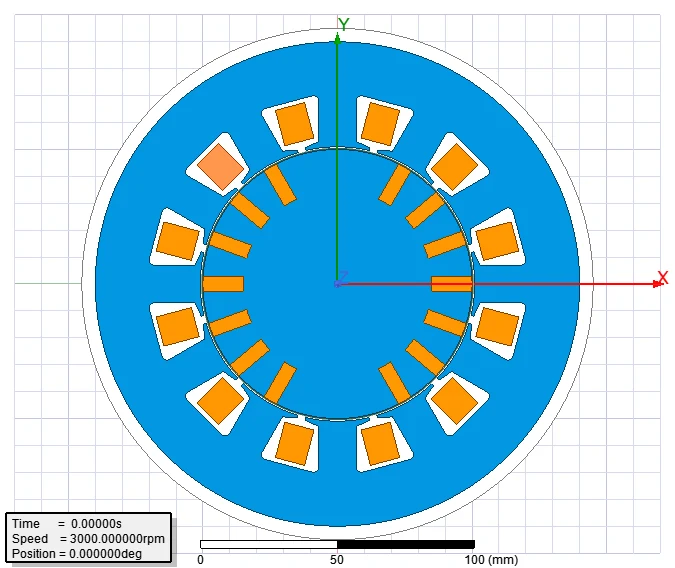
The machine is a two-pole, three-phase, wound-field synchronous design. The stator and rotor cores are M19 electrical steel, with a model depth of 45 mm. The stator carries a distributed three-phase winding with two slots per pole per phase, twelve slots in total, at 180 turns per coil, while the rotor carries a DC field winding of 55 turns per slot driven by a 1 A field current.
It was solved with the transient solver, with vector potential boundary conditions on the outer region and mesh controls refining the stator and rotor cores. This is the setup that lets the field, the voltage, and the torque all come out of one simulation.
Magnetic Field: Flux Lines and Flux Density
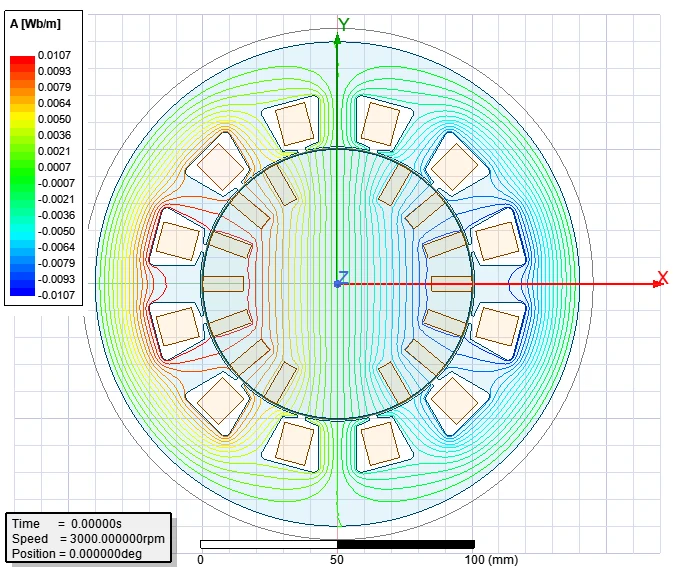
With the rotor turning at 3000 rpm on open circuit, the simulation gives the field that drives the machine. The flux lines show the magnetic circuit closing through the stator and rotor cores and crossing the airgap, with a peak flux line value of about 0.0107 Wb/m.
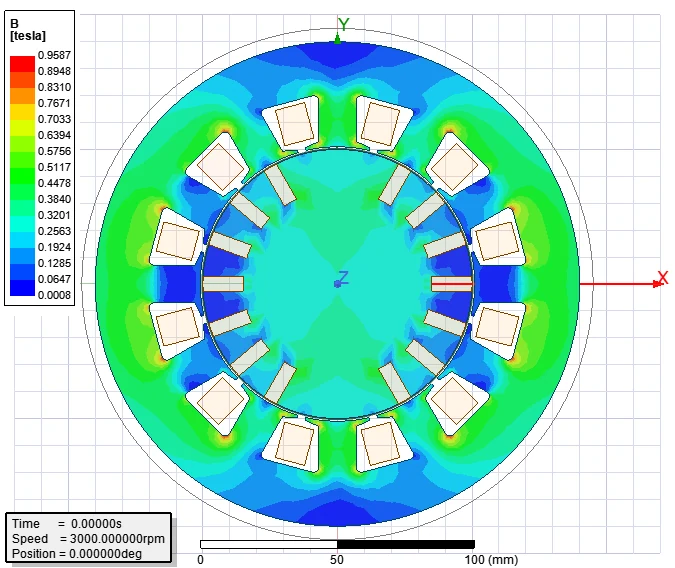
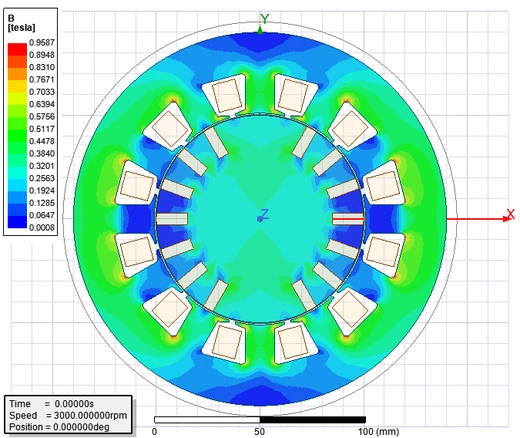
The flux density contour at the top of this page shows how strong that field is across the machine, peaking at about 0.9587 T in the core. Read together, the two plots show both the shape of the magnetic circuit and where the steel is working hardest.
Airgap Flux Density and Induced Back-EMF
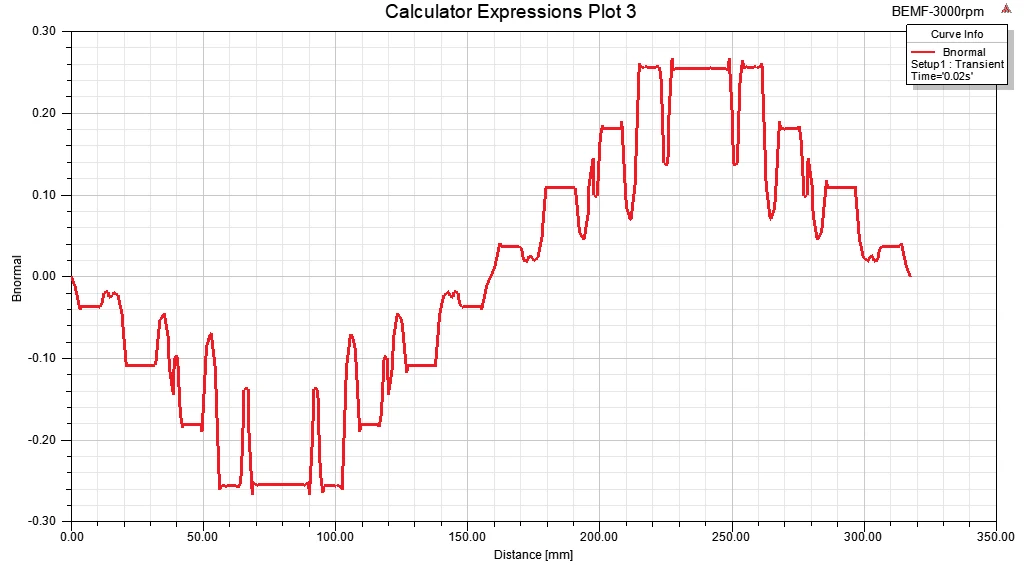
Plotting the flux density around a circle in the middle of the airgap shows how the field is distributed from one pole to the next. That airgap field is what sweeps past the stator winding as the rotor turns, and its shape is what sets the shape of the induced voltage.
The result is a clean three-phase set of back-EMF voltages in the stator winding, peaking at about 2.50 V. This is the voltage the machine would generate at this speed, and how smooth and balanced it is, is a direct read on how good the magnetic design is.
Torque at Standstill and at Speed
The torque was then computed at standstill and at speed. At 0 rpm the developed torque swings with an amplitude of about 10.78 Nm as the rotor position changes, which shows how the torque depends on the angle between the stator field and the rotor.
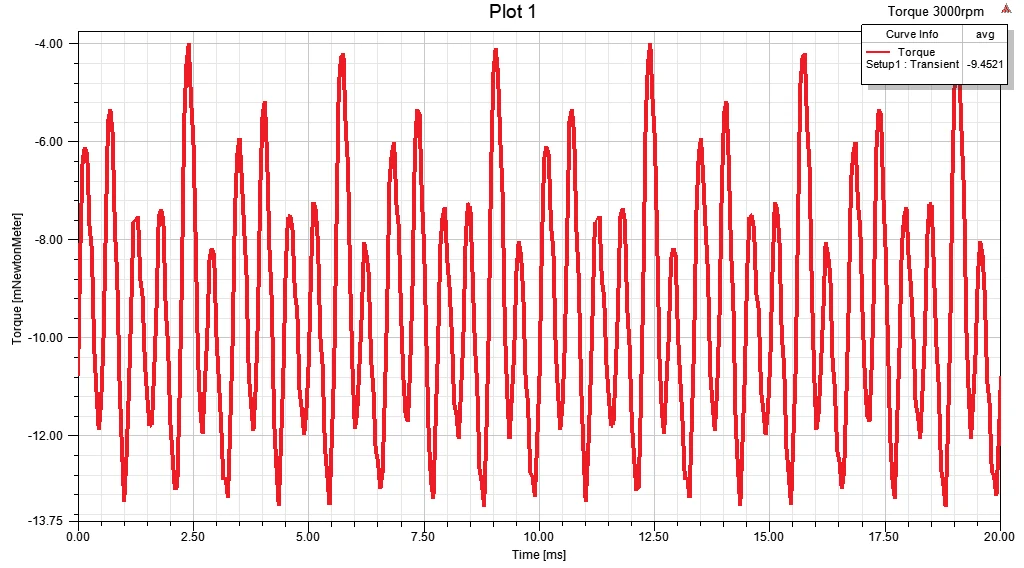
At 3000 rpm the machine settles to an average torque of about -9.45 Nm, with the sign just showing the direction. Shifting the phase angle to pi/2 drops that average to about -0.47 Nm, which is the core of how a synchronous machine is controlled: the same machine gives very different torque depending on where the field is aligned.
Conclusion
From a single 2D transient model, the simulation delivers the full electromagnetic picture of the machine: the flux lines and flux density that show the field, the back-EMF that shows the voltage it generates, and the torque that shows the work it can do. That is the kind of result that lets an electric machine be understood and improved on the screen, before any lamination is cut or any coil is wound.
Electric Machine and Electromagnetic FEA at Solvo Engineers
Electric machines live or die on their electromagnetics, and the field, the voltage, and the torque are all tied together in a way that is hard to judge without simulation. Electromagnetic FEA shows all three at once, so a motor or generator can be sized, checked, and tuned before it is built.
At Solvo Engineers we run electromagnetic FEA in Ansys Maxwell for motors, generators, and other electric machines, covering flux density, back-EMF, torque, losses, and winding design. If you are developing an electric machine and need its performance understood, our team can help. Reach out through our contact page and talk it through with a simulation engineer.
Related articles
Our Projects
See how Solvo Engineers has helped its clients achieve their vision of digital innovation.
Our Technologies
 Contact Us
Get in touch with us