
Home / Projects / Aircraft Impact Simulation on Foam Using Ansys Explicit Dynamics
Aircraft Impact Simulation on Foam Using Ansys Explicit Dynamics
Foam is one of the most useful materials in crash protection. It is light, and when something hits it hard the foam crushes and soaks up the energy of the impact instead of passing it straight through. This project used an explicit dynamics simulation in Ansys to fire an aircraft-shaped body into a foam structure and watch how the foam behaves at the moment of impact. The goal was to see where the stress builds up and how the material deforms when the crash load arrives.
This is a job that only an explicit dynamics solver can do properly. An impact happens in a tiny slice of time, with the load changing from nothing to everything and back again almost instantly, and a normal static analysis simply cannot capture that. The simulation was run with the Ansys AUTODYN explicit solver, which is built for exactly these short, violent events, and it produced both the stress picture and the deformation picture of the foam under the strike.
Objectives
The aim was to capture the impact event itself and understand how the foam responds while it happens. The objectives were:
- Set up an aircraft striking a foam structure as a true impact event, not a static load.
- Find where the stress concentrates in the foam at the moment of contact.
- See how the foam deforms as it takes the hit and starts to absorb the energy.
- Show that an explicit dynamics model can represent this kind of crash behaviour for foam.
Impact Setup in Ansys Explicit Dynamics
The simulation was built in Ansys Explicit Dynamics using the AUTODYN solver, which is designed for short-duration impact and blast events where the flow of stress waves through the material matters. The main elements of the setup were:
- Solver: Ansys Explicit Dynamics with AUTODYN, run as a transient impact through a sequence of very small time steps.
- Initial condition: a velocity applied to the aircraft body so that it strikes the foam, which is what drives the whole event.
- Constraint: a fixed support holding the foam structure in place so the impact loads it rather than simply pushing it away.
- Outputs: equivalent von Mises stress and directional deformation, so both the loading and the movement of the foam could be read.
An explicit solver marches forward in extremely small time steps because it is tracking stress waves travelling through the material as the impact lands. That is heavier to compute than a static analysis, but it is the only way to see the real sequence of an impact rather than a single frozen snapshot of a steady load.
Stress Response of the Foam
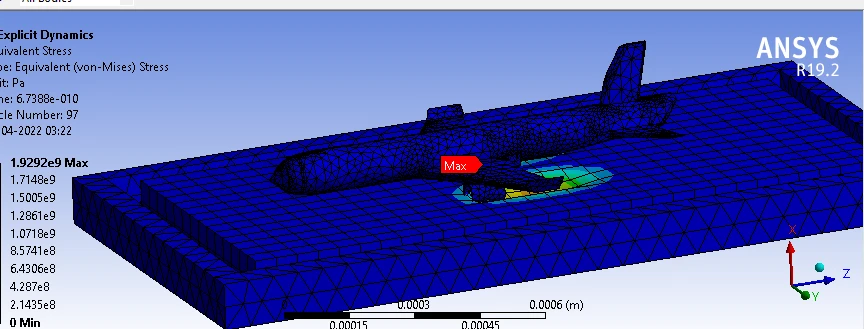
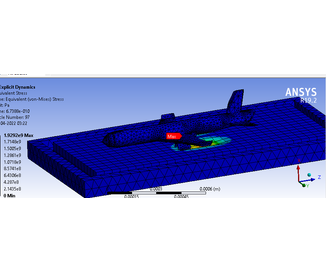

The equivalent von Mises stress result, shown above, makes the impact easy to read at a glance. Almost the whole foam structure stays a calm low-stress blue, while a sharp, bright concentration of stress appears right at the point where the aircraft makes contact. That is exactly what an impact should look like: the energy of the strike is dumped into a small local region first, and the rest of the structure only feels it later as the stress spreads outward.
This localised pattern is the key to how energy-absorbing foam is meant to work. By taking the peak load in a concentrated zone and crushing there, the foam protects everything behind it. Seeing the stress focus cleanly at the contact point, rather than smearing across the whole part, is a sign the impact is being captured properly and that the foam is doing its job of catching the hit where it lands.
Deformation and Foam Behaviour
The deformation result shows the other half of the story, which is how the foam actually moves as it is struck. The directional deformation contour maps how far the material is pushed in the direction of the impact, and it lines up with the stress result, with the largest movement sitting where the aircraft drives into the foam and tailing off through the rest of the body.
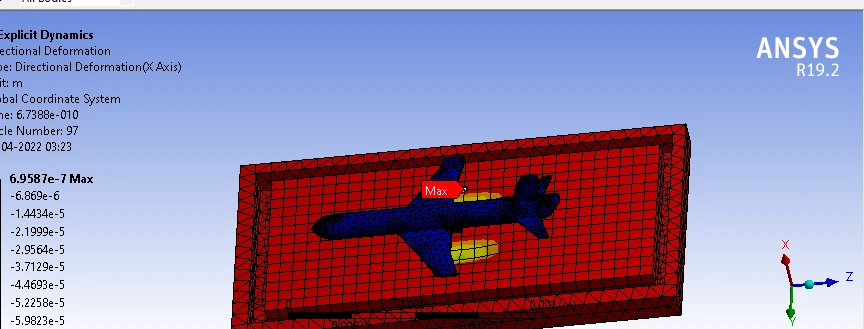
Reading the stress and deformation together gives a complete view of the foam under impact: where it is loaded hardest, and where and how far it deflects to absorb that load. That pairing is what makes an impact model useful, because energy-absorbing foam is judged not just on how much stress it sees but on how it deforms to soak the impact up. From a baseline model like this, the same setup can then be pushed further to compare foam densities, thicknesses, or impact speeds and see how the response changes.
Impact and Crash Simulation at Solvo Engineers
Impact, crash, and drop events are some of the hardest problems in mechanical engineering, because everything happens in a fraction of a second and the materials are pushed far past their gentle everyday behaviour. Explicit dynamics is the right tool for these events, and it is how energy-absorbing materials like crash foam, packaging, and protective structures get tested long before a physical drop test. Getting the behaviour right on screen saves the cost and time of building and smashing one prototype after another.
At Solvo Engineers we run explicit dynamics impact and crash simulations in Ansys, covering foam and energy absorbers, drop tests, and impact loading, alongside our wider FEA and CFD consulting work. If you have an impact, crash, or energy-absorption problem you need to understand before it is built, our team can help. Reach out through our contact page and talk it through with a CAE engineer.
Our Projects
See how Solvo Engineers has helped its clients achieve their vision of digital innovation.
Our Technologies
 Contact Us
Get in touch with us