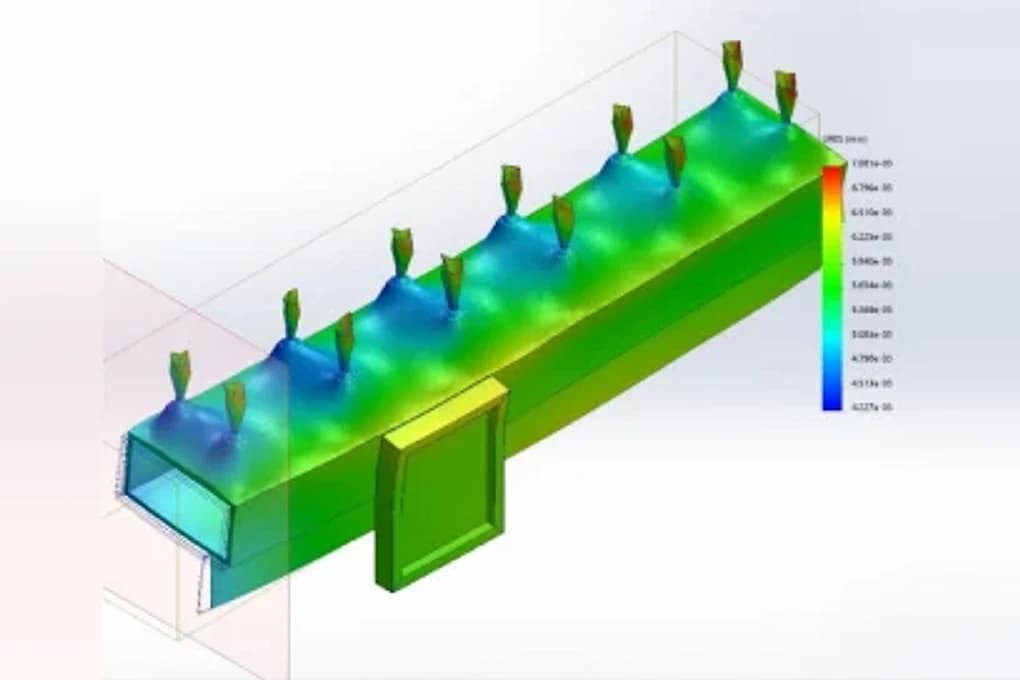
Project overview
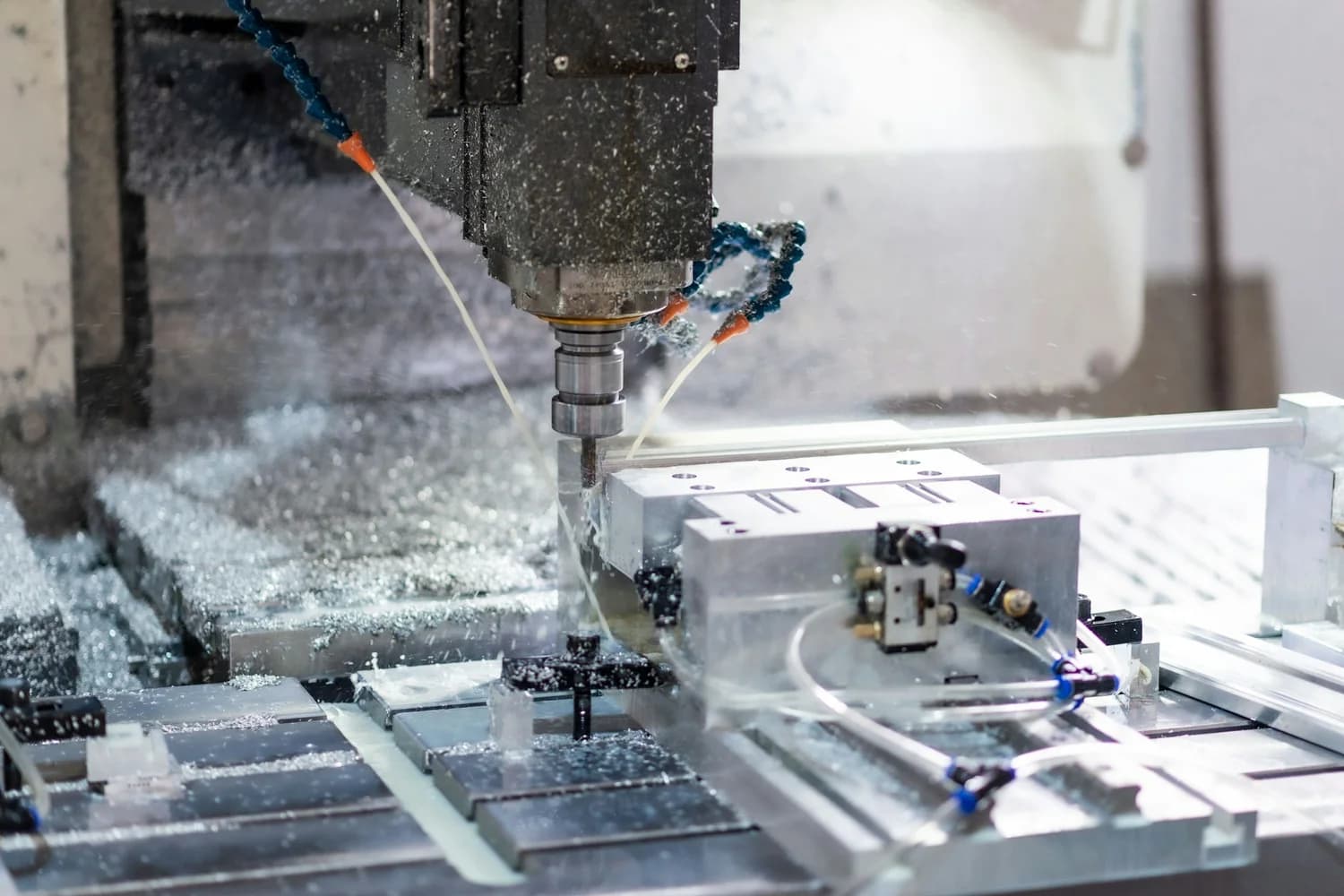
Fixtures hold and support parts during manufacturing, so they must be strong and, above all, stiff: any deflection under load moves the part being worked on. A fixture that is too heavy, on the other hand, costs more material and is harder to handle.
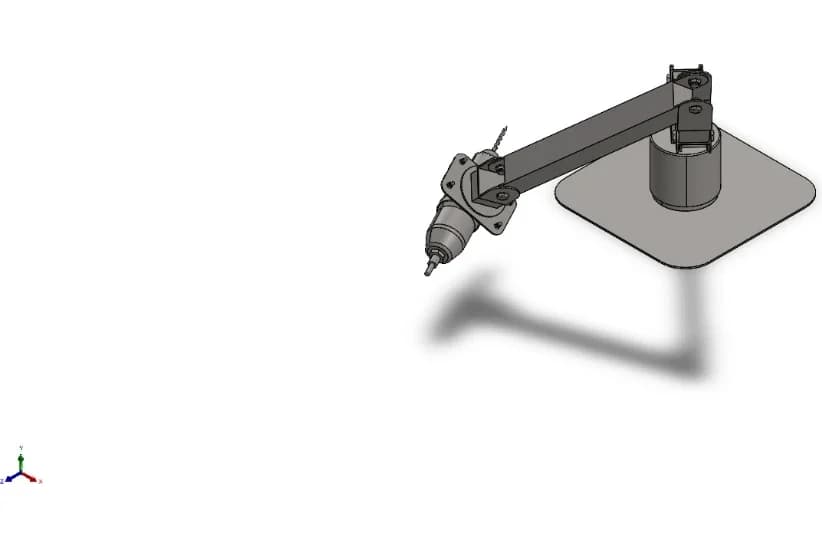
In this project we ran a finite element analysis (FEA) of a custom-designed industrial fixture assembly under static load in SolidWorks Simulation. We assessed its strength, displacement, strain and factor of safety, found the stress concentrations and design margins, and identified where the geometry could be optimised for high stiffness at a lower weight.
Objectives
How we set up the fixture FEA
Assembly model
The complete multi-part fixture assembly was analysed, rather than single parts, so the load paths between the components were included.
Contacts
Bonded contact conditions between the parts of the assembly.
Mesh
A global mesh across the whole multi-part assembly in SolidWorks Simulation.
Load
A force of 7,664.79 N (nearly 7.7 kN) applied in the Y direction, representing the operating load.
Results
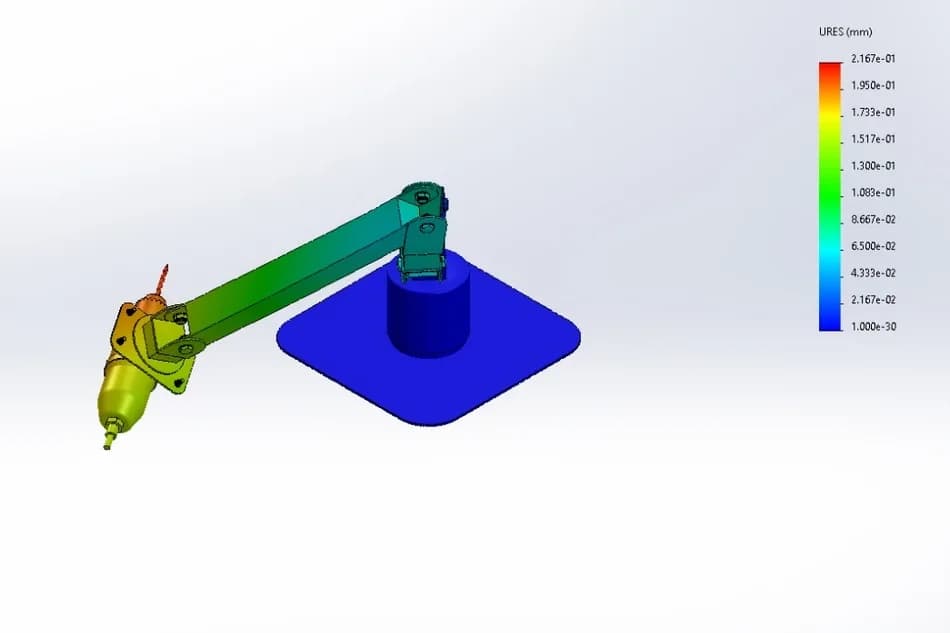
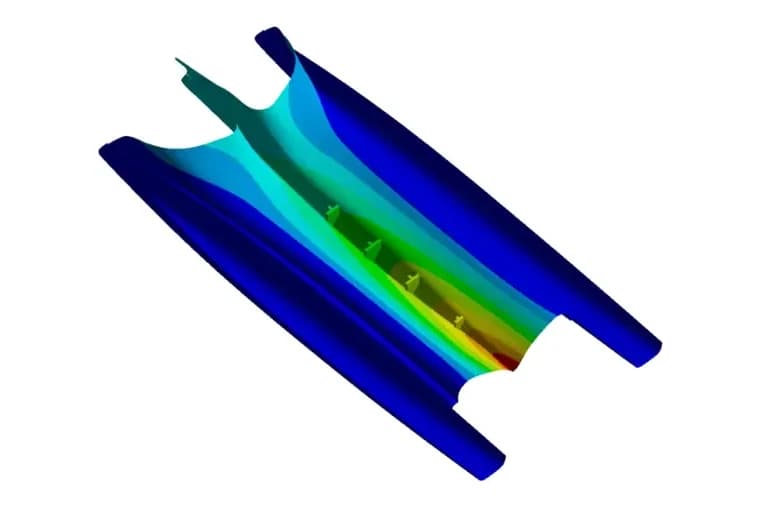
Von Mises stress, displacement, equivalent strain and factor of safety, checked across every component.
Results: stress, displacement, strain and safety factor
| Result | Value | What it means |
|---|---|---|
| Maximum von Mises stress | 146.8 MPa | At connection points and mounting interfaces, well within the steel's yield strength |
| Maximum displacement | 0.00708 mm | Minimal deflection: the fixture is very stiff |
| Maximum equivalent strain | 4.072 × 10⁻⁴ | Evenly distributed and within the elastic range |
| Minimum factor of safety | 4.43 | At the most highly stressed point; a conservative, robust design |
Where the design can be optimised
The fixture is structurally sound, with low deformation, acceptable stresses and a high safety margin, and its tiny deflection under nearly 7.7 kN suits both heavy-duty and precision manufacturing. With a minimum safety factor above 4, there is also clear room to optimise the geometry:
Why FEA early in fixture design pays off
Checking a fixture with FEA before it is built confirms that it will perform, shows how much margin it really has and reveals where material can be saved. Used early in development, this design-to-validation workflow ensures structural reliability and cuts prototyping costs.
Frequently asked questions
How strong is the fixture under its working load?
Under 7,664.79 N in the Y direction, the maximum von Mises stress was 146.8 MPa, at local connection points and mounting interfaces, and the minimum factor of safety was 4.43, a conservative and robust design.
How much does the fixture deflect?
Very little: the maximum displacement was 0.00708 mm, and the strain stayed uniform and elastic throughout, so the fixture is stiff enough for precision work.
Could the fixture be made lighter?
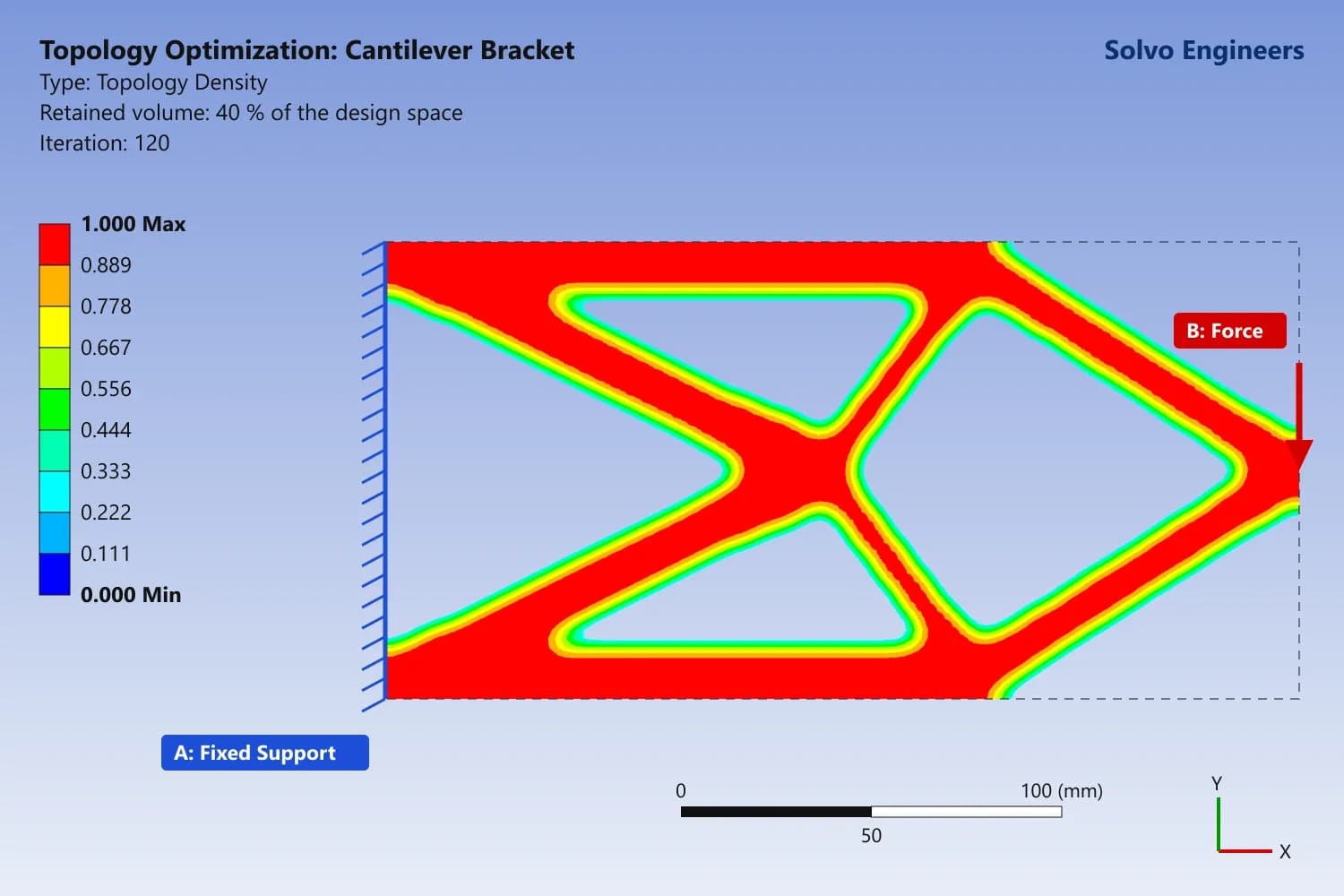
Yes. With a minimum safety factor above 4, material can be removed from low-stress regions, fillet radii and hole positions can be adjusted to remove stress concentrations, and the geometry simplified for cheaper manufacturing, without compromising strength.
How was the fixture modelled in SolidWorks Simulation?
As a complete multi-part assembly with bonded contacts and a global mesh, under a static load of 7,664.79 N in the Y direction, with von Mises stress, displacement, strain and factor of safety evaluated across all the components.