Project overview
CubeSats are small satellites built from 10 cm cubes; a 1U CubeSat is a single cube. Before it ever reaches orbit, the structure must carry the accelerations and vibration of the launch. Once in low Earth orbit, it passes from full sunlight into Earth's shadow and back on every orbit, so the frame heats, cools and changes shape again and again.
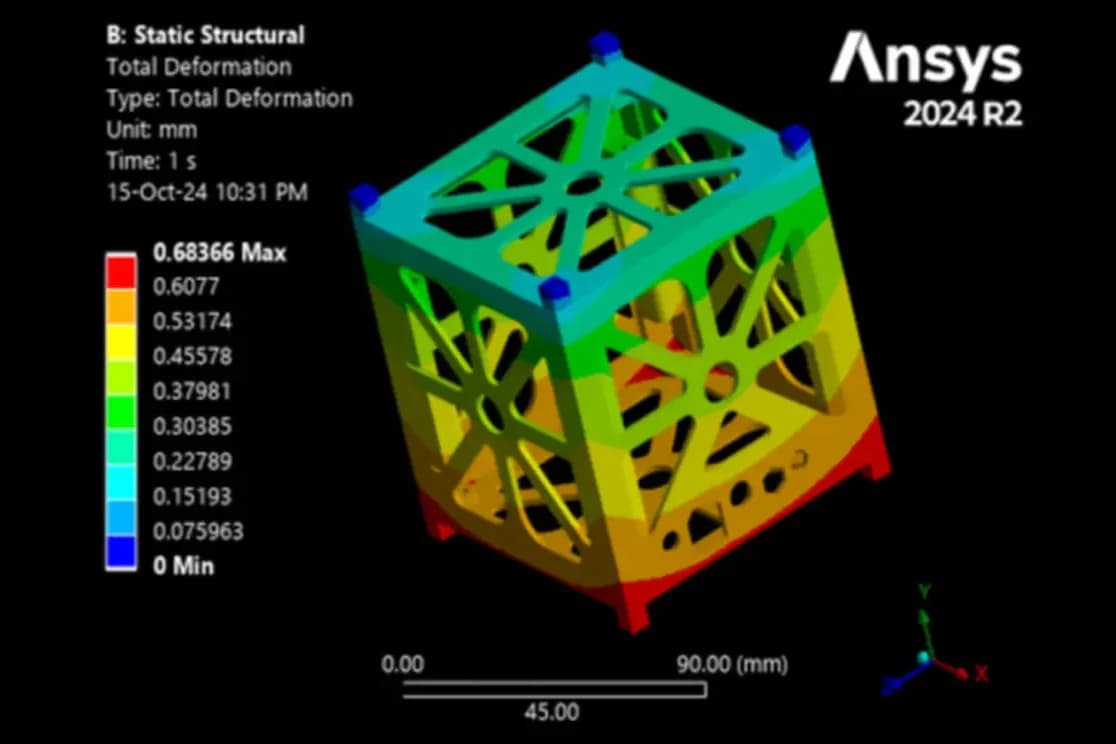
Checking those loads one at a time can hide the real risk, because thermal expansion adds its own stresses on top of the mechanical ones. In this project we ran a coupled thermal-structural finite element analysis (FEA) of a standard 1U CubeSat for low Earth orbit, applying the thermal cycle and the launch loads together to see how the structure behaves across its mission.
Objectives
The study had to show that the structure carries the combined loads without failure, permanent deformation or loss of function, and where it could be made more robust:
How we built the CubeSat FEA model
We built a detailed finite element model of the whole structure in Ansys Workbench and solved it in two linked steps: first the temperatures through an orbit, then the stresses those temperatures and the launch loads create.
Geometry and mesh
Outer panels, internal frames, fasteners and the PCB mounting surfaces were all modelled. The mesh was refined around screw holes, joints and the electronics housing interfaces, where the stress peaks were expected.
Transient thermal analysis
A transient heat transfer analysis followed the CubeSat through the orbital thermal cycle, with solar heat flux coming in and heat radiating out to deep space.
Coupled thermal-structural analysis
The computed temperatures drove the structural model, capturing thermal expansion and contraction and the differential expansion between the aluminium frame and the composite housings.
Launch load cases
Accelerations of up to 20 g were applied in several directions to represent launch, with the CubeSat held at its deployer interface points.
Results review and design changes
Stress, deformation and fatigue potential were reviewed across the load cases, and the geometry was refined where the stresses concentrated.
Loads, boundary conditions and materials
The inputs represent the environment a CubeSat meets from launch to orbit. Material properties were temperature dependent, so the solver handled the nonlinear behaviour across the whole cycle.
| Input | Value | What it represents |
|---|---|---|
| Thermal cycle | −40 °C to +85 °C | Passing between sunlight and Earth's shadow in orbit |
| Heat flux | Solar in, deep space out | Solar radiation and radiation to deep space |
| Launch acceleration | Up to 20 g | Rocket ascent, applied in several directions |
| Supports | Deployer interface | Fixed where the CubeSat is held in its deployer |
| Frame | Al 7075-T6 | Aerospace-grade aluminium alloy structure |
| Electronics housings | Polymer composite | Thermally stable housings for the electronics |
Results: where thermal loads raise the stress
Under every simulated case the structure stayed within acceptable stress limits, but the coupled analysis showed effects a launch-load check alone would miss:
The coupled result is drawn at the middle of the 15–18% range found in the study.
Design recommendations
Based on the results we recommended two small geometry changes that keep within the mass budget:
The modified design gave a better thermal stress distribution and more efficient load transfer, and reduced the risk of fatigue or deformation during launch and in orbit.
Why coupled analysis matters for CubeSats
A CubeSat frame never sees its loads one at a time. The same joints that carry the launch loads also expand and contract with every orbit, and repeated thermal cycles add up as fatigue. In this study, adding the thermal loads raised the peak stress by up to 18%, so analysing the loads together is essential for a structure that has to work first time, far beyond the reach of repairs.
Frequently asked questions
Why combine thermal and mechanical loads in one CubeSat analysis?
Because the structure carries them together: thermal expansion adds stress on top of the launch loads. In this study, combining them raised the peak von Mises stress by about 15–18% compared with the mechanical loads alone, so a mechanical-only check would have underestimated the worst stresses.
What temperatures and launch loads were simulated?
Thermal cycling between −40 °C and +85 °C, with solar heat flux in and radiation to deep space out, to represent passing between sunlight and Earth's shadow; and launch accelerations of up to 20 g applied in several directions, with the CubeSat held at its deployer interface points.
Which software was used for the CubeSat simulation?
Ansys 2024 R2 in Workbench: a transient thermal analysis whose temperatures drove a static structural analysis, with temperature-dependent material properties for the aluminium 7075-T6 frame and the composite electronics housings.
Which design changes improved the CubeSat structure?
Fillets at the sharp internal intersections and optimised panel thickness. Together they improved the thermal stress distribution and load transfer and reduced the risk of fatigue and deformation, while staying within the mass budget.