Project overview
Catamarans are prized for their stability, deck space and efficiency, but their structure works differently from a single hull. The two hulls are joined by a bridging deck that has to hold them together as the boat is loaded and moves through the water, and that connection is where a catamaran's structure is tested hardest.
In this project we built a finite element (FEA) model of the complete hull structure, with both hulls, the bridging deck and the internal bulkheads, and used it to optimise the structure with bulkheads: to see where the load concentrates and where bulkheads make the hull stiffer and stronger.
Objectives
The model
The model covers the whole structure: the two hulls, the bridging deck between them and the row of bulkheads along the centre of the deck. Modelling the full hull, rather than one section of it, lets the load travel through the structure as it does on the real boat: from the deck, through the bulkheads, into the hulls.
That matters for a catamaran in particular. The bridging deck ties the two hulls together, so its stiffness, and the bulkheads that support it, decide how the whole boat carries load.
Results
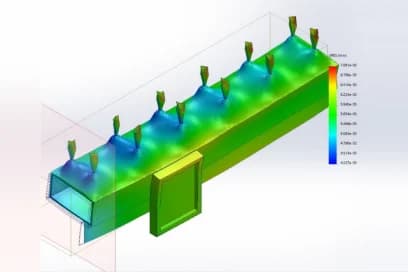
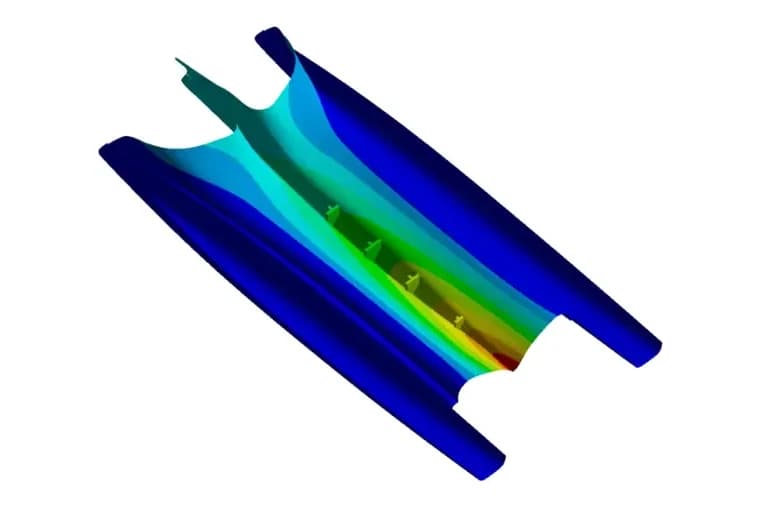
The result plot at the top of this page shows how the structure responds:
That pattern shows the bridging structure doing the main structural work, and it points straight to where bulkheads earn their place: supporting the deck and tying it into the hulls, where the load is highest.
Why bulkheads matter
Bulkheads are the transverse walls inside a hull. They support the hull panels and the deck against bending and twisting, divide the hull into compartments and tie the whole structure together. Placed well, they add a lot of stiffness and strength for little extra weight; placed badly, they add weight without helping. An FEA model of the full hull shows which is which, so the bulkhead layout can be set from evidence rather than rule of thumb.
Frequently asked questions
Why use FEA on a catamaran hull?
Because a twin-hull structure carries load in a way hand calculations struggle with. The bridging deck has to hold the hulls together as the boat is loaded and moves, and FEA shows how the load travels through the hulls, the deck and the bulkheads, and where it concentrates.
What do bulkheads do in a catamaran?
Bulkheads are transverse walls inside the hull and deck structure. They support the panels, resist bending and twisting, divide the hull into compartments and tie the structure together. Well placed, they add stiffness and strength for little extra weight.
Where is a catamaran's structure most heavily loaded?
Typically in the bridging structure that joins the two hulls. In this model the highest values appear on the bridging deck between the hulls, while the hulls themselves stay lightly loaded.
Can the model test different bulkhead layouts?
Yes. Once the hull model is built, bulkhead positions and thicknesses can be changed and compared on screen, before anything is built.