
This project looks at a car bonnet built from natural fiber composite and asks a direct question: can a lightweight, sustainable material carry the loads a bonnet sees, and how does it behave when something hits it. Answering that means going past a single stress number and into how a composite actually fails, so the study uses ANSYS to run a full composite analysis with proper fiber and matrix failure criteria, followed by an explicit dynamics impact test.
Two materials were put through exactly the same analysis so the comparison is fair: FFREC, a flax fiber reinforced epoxy composite, and JFREC, a jute fiber reinforced epoxy composite. Each one was analysed for equivalent stress, total deformation, and fiber and matrix damage on the bonnet, and then the impact case was solved in explicit dynamics to see how the panel deforms and where damage begins under a sudden load.
Objectives
The aim was to judge a natural fiber composite bonnet on strength, stiffness, and damage tolerance, and to do it in a way that lets the material choice be compared cleanly. The objectives were:
- Model the car bonnet as a natural fiber composite and check whether it carries its loads without failing.
- Compare two candidate materials, FFREC (flax fiber) and JFREC (jute fiber), under identical geometry, mesh, constraints, and loads, so the material is the only variable.
- Apply composite failure criteria that separate fiber failure from matrix failure, in both tension and compression, rather than a single stress limit.
- Run an explicit dynamics impact test to capture how the bonnet deforms and where damage initiates under a sudden load.
Materials and Failure Criteria
Both materials are natural fiber reinforced epoxy composites. FFREC uses flax fiber and JFREC uses jute fiber, each set in an epoxy matrix. Materials like these are drawing real interest in automotive body panels because they are light, lower cost, and more sustainable than glass fiber, while still stiff enough for parts like a bonnet. The question is never whether they are light, it is whether they are strong and tough enough, and that is exactly what the analysis is built to answer.
A composite does not behave like a metal, so it cannot be judged with a single stress limit. Each material was modelled as orthotropic, meaning its stiffness and strength are different along the fibers than across them. The failure model uses orthotropic stress limits with separate tensile and compressive strengths, and it splits failure into two distinct modes: fiber failure, where the reinforcement itself gives way, and matrix failure, where the epoxy around the fibers cracks. Tracking these separately matters because a panel can suffer matrix cracking long before the fibers break, and the two mean very different things for how the part holds up.
Once a stress limit is reached, the model degrades the stiffness of the failed material rather than treating it as intact, so the results show not just where failure starts but how damage spreads as load builds. This is what turns a stress plot into a real damage analysis.
FEA Setup
The bonnet geometry was meshed and the composite material assigned, with the panel restrained the way it sits on a vehicle and loaded to represent its working conditions. The analysis ran in two stages:
- A composite stress analysis for each material, capturing equivalent von-Mises stress, total deformation, and the fiber and matrix damage across the bonnet.
- An explicit dynamics analysis for the impact case, which resolves the fast, transient response that a standard static solver cannot.
- The same setup applied to both FFREC and JFREC, so any difference in the results comes from the material and nothing else.
Results for FFREC (Flax Fiber Composite)
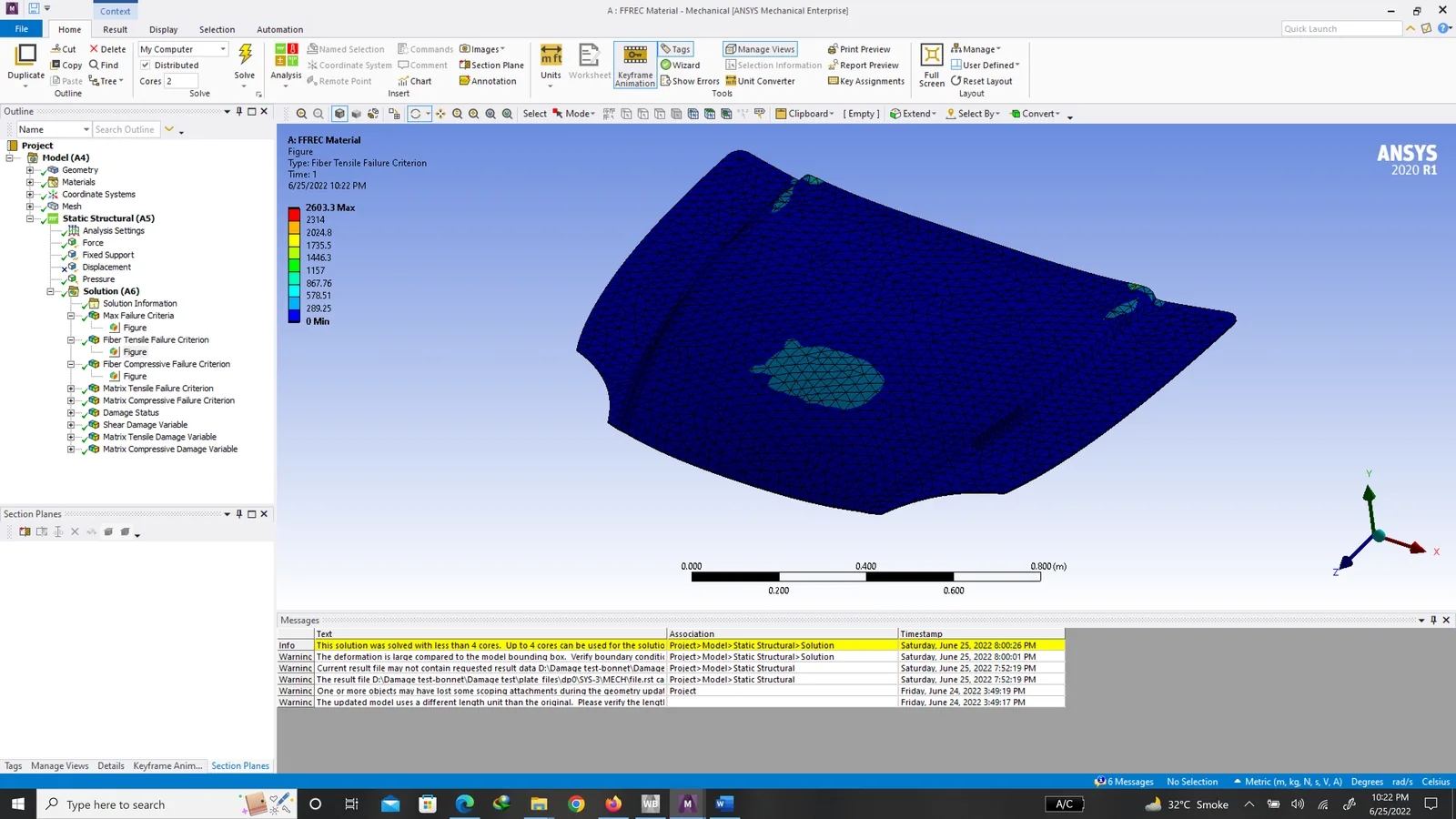
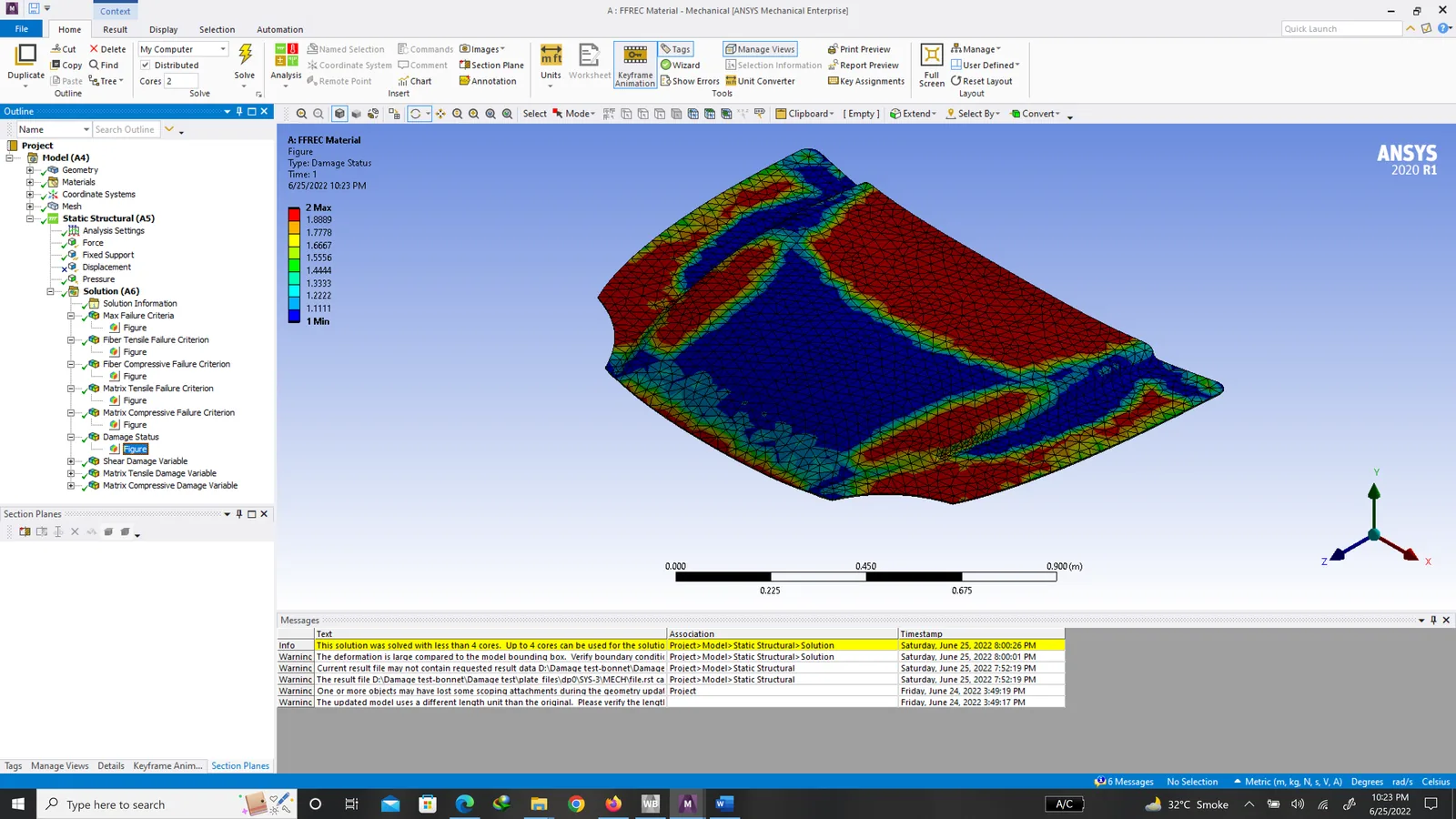
The stress contour for the flax fiber bonnet, shown at the top of this page, maps how load travels through the panel and where it concentrates around the edges and mounting regions. The equivalent von-Mises stress field makes the load path easy to read and points straight to the areas that carry the most, which are the places any failure would start.
The composite damage result takes it further. Instead of a single stress figure, it shows where the fiber and matrix failure criteria are reached and how far that damage reaches into the panel. Seeing the damage pattern on the flax bonnet is what tells you whether the material is genuinely holding the load or quietly cracking in the matrix, which is the difference between a panel that lasts and one that does not.
Results for JFREC (Jute Fiber Composite)
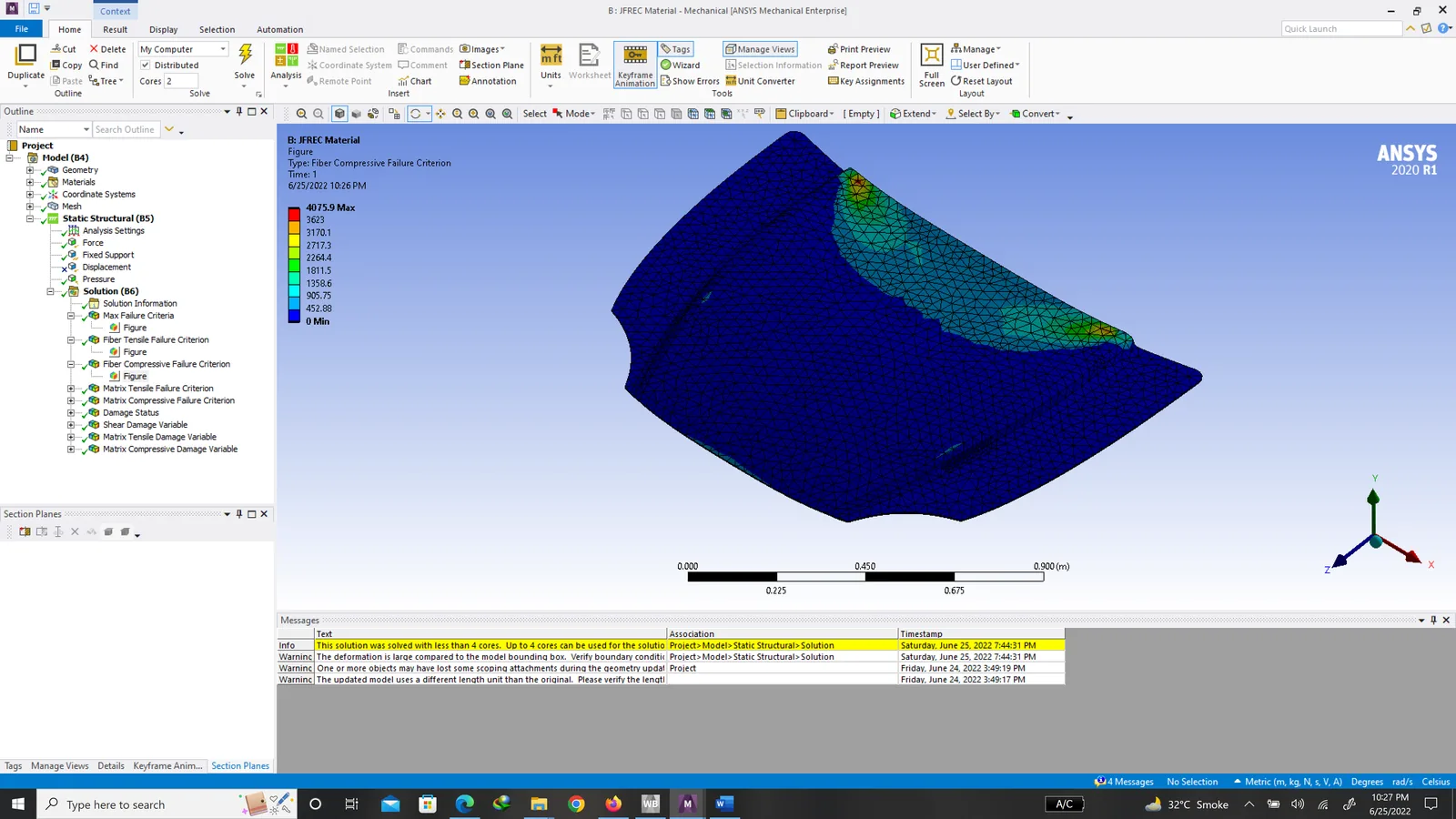
The jute fiber bonnet was put through the same treatment for a direct comparison. Its stress contour shows the load path across the panel under identical conditions, giving a clean like-for-like result to hold against the flax design. Because the geometry, mesh, restraints, and loads are all the same, the stress field here reflects the jute material on its own.
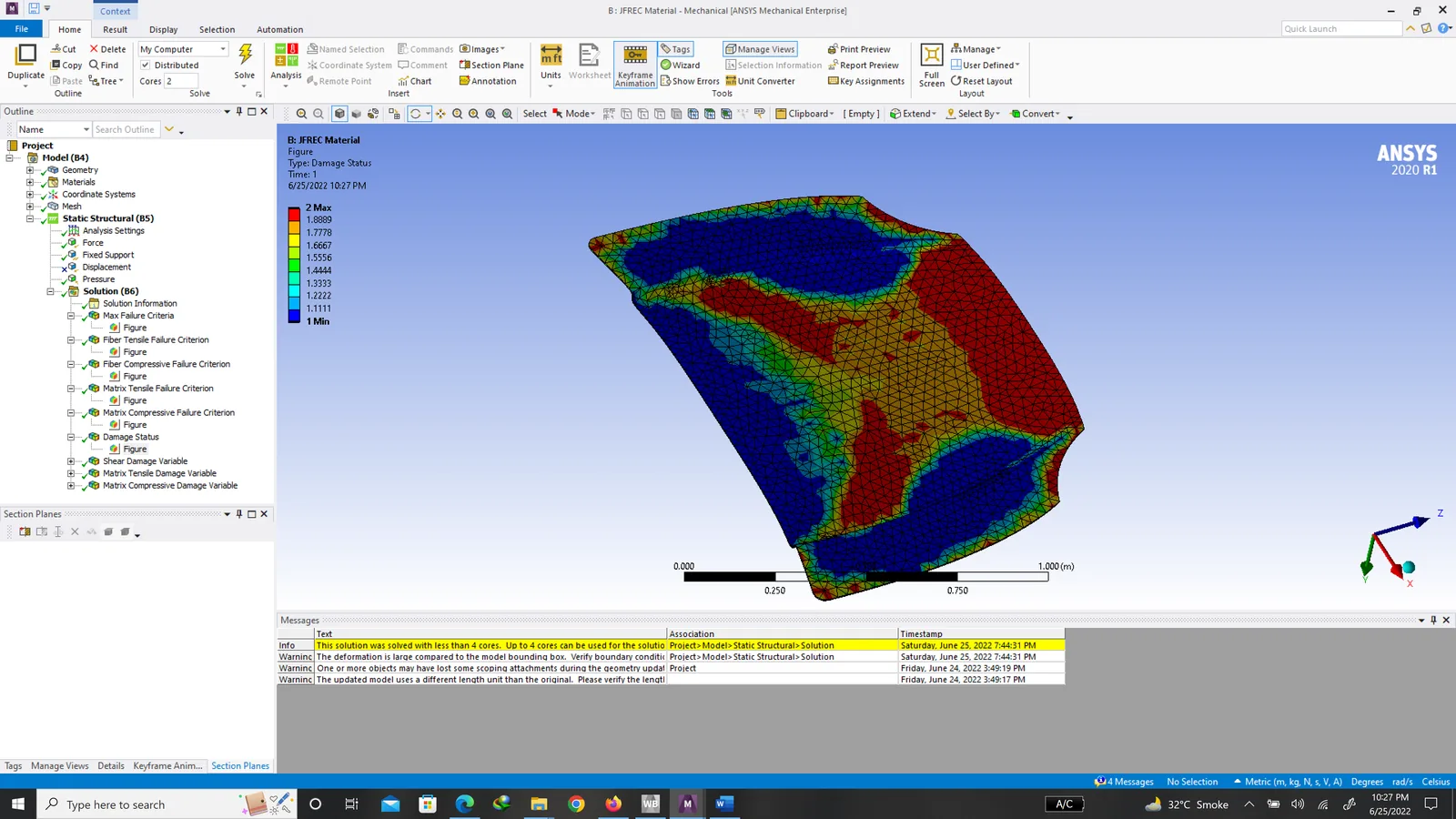
The damage result for the jute bonnet shows where its fiber and matrix failure criteria are reached and how the damage is distributed. Set next to the flax result, it is this pair of damage plots that decides the material question, because they show which composite keeps its damage smaller and more contained under the same demand.
Explicit Dynamics Impact Test
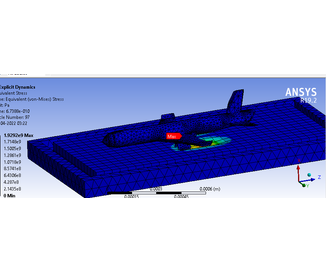
A bonnet does not only sit under static load, it gets hit. The impact case was solved in explicit dynamics, which is built for fast, transient events where the load is applied and released in a fraction of a second. This is the analysis that shows how the composite panel actually responds to a sudden strike, rather than a slow, steady push.
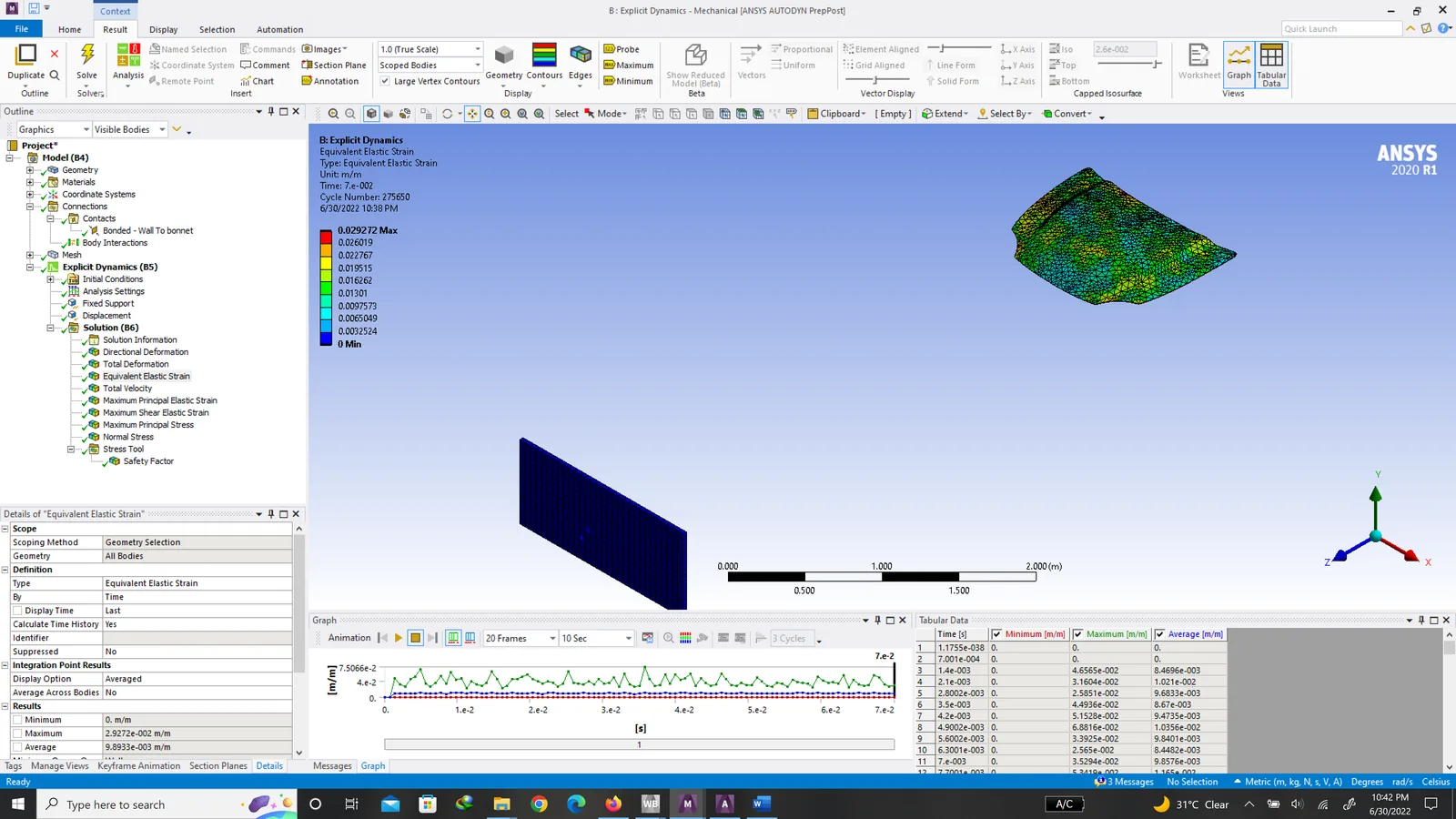
As the impact develops, the results track how the bonnet deforms and where the material starts to give. The stress and deformation fields move through the panel as the event unfolds, and the damage output shows the point where the fiber and matrix failure criteria are first reached under the strike.
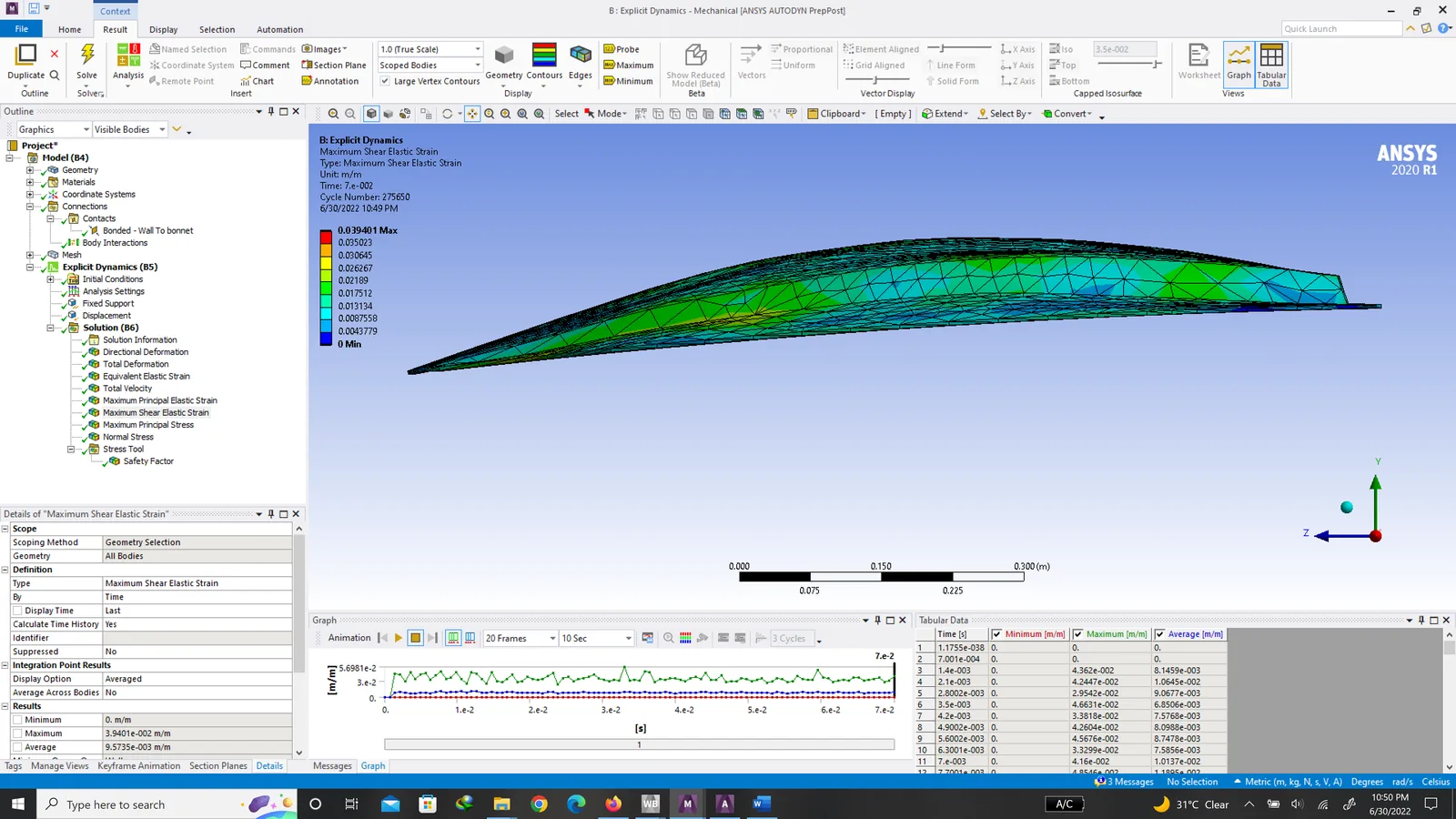
By the end of the impact, the result shows the final deformation of the bonnet and the full extent of the damage left behind. This is the information that matters most for a real panel: not just whether it moves, but how much permanent damage a strike leaves in the composite, and whether that damage stays local or spreads across the part.
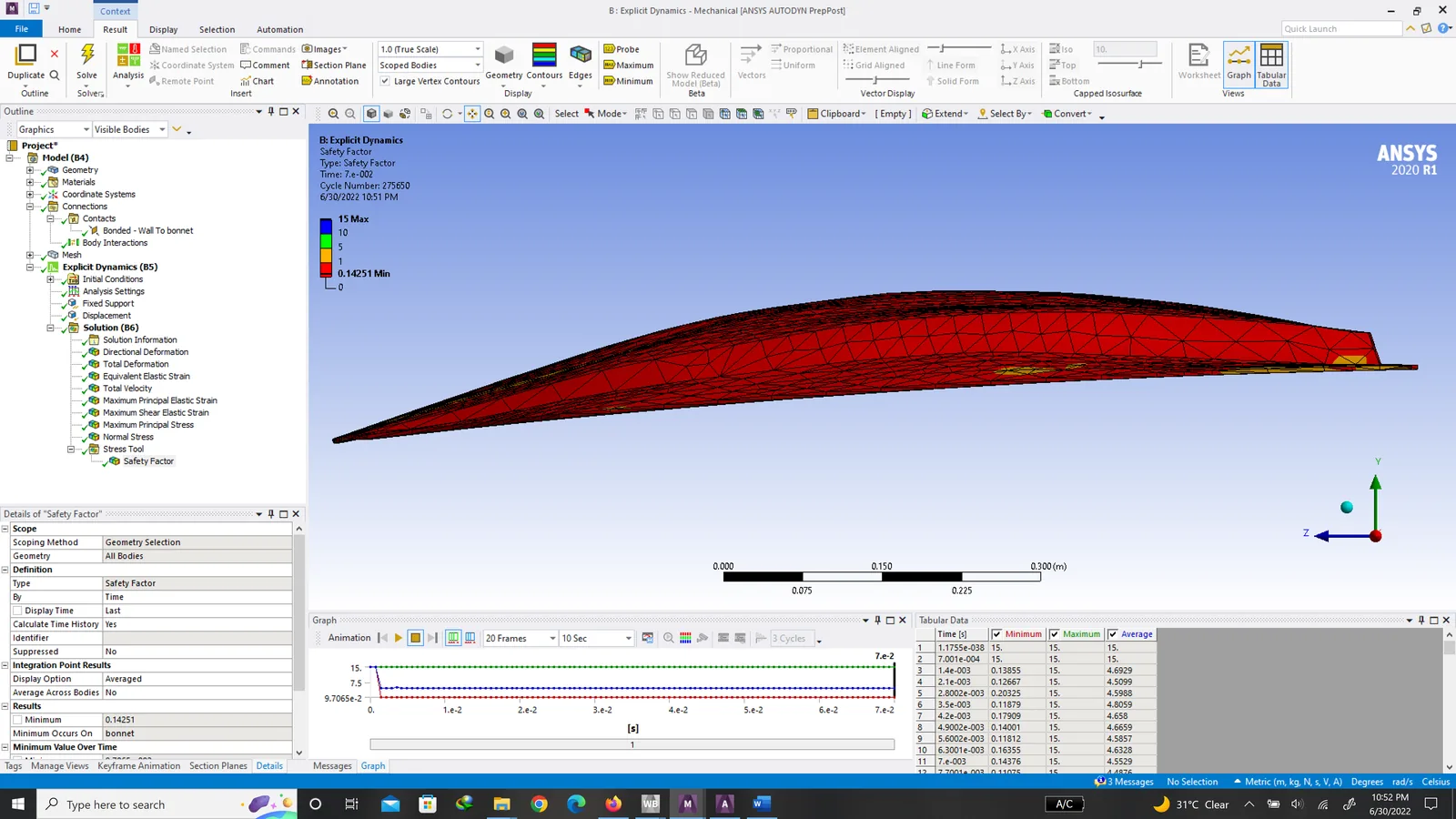
Comparing the Two Materials
The value of running both materials the same way is that the comparison is honest. Same bonnet, same mesh, same restraints, same loads, so every difference in stress, deformation, and damage comes from the fiber itself. Reading the flax and jute results side by side turns the study from a description of one panel into a real material decision, which is exactly what you need before committing to a design.
Both the static composite analysis and the explicit dynamics impact test point to the same kind of answer: which material keeps its stress and deformation lower, and which one holds its fiber and matrix damage smaller and more contained under the same demand. That is the practical output of the whole project, a clear basis for choosing between a flax and a jute reinforced bonnet on engineering grounds rather than guesswork.
Conclusion
Put together, the study shows a complete workflow for a composite car bonnet in ANSYS: model the panel, assign a natural fiber composite, apply fiber and matrix failure criteria with stiffness degradation, and run both a static analysis and an explicit dynamics impact test. Doing this for both FFREC and JFREC shows whether a sustainable natural fiber bonnet is viable at all, and which of the two materials stands up better to load and impact. That is a decision made on analysis, before any physical prototype is built or tested.
Composite and Impact FEA at Solvo Engineers
Composite parts fail differently from metal ones, and getting that wrong means a design that looks fine on a stress plot but cracks in service. Proper composite FEA separates fiber failure from matrix failure, tracks how damage spreads, and tests the part under impact as well as steady load, which is what this bonnet study does from start to finish.
At Solvo Engineers we run composite FEA and explicit dynamics in ANSYS for automotive panels, natural fiber and glass or carbon composites, and other structural parts, covering equivalent stress, total deformation, fiber and matrix failure, and impact and crash loads. If you are developing a composite component and need to know whether it holds up and which material to use, our team can help. Reach out through our contact page and talk it through with a CAE engineer.
Related articles
Our Projects
See how Solvo Engineers has helped its clients achieve their vision of digital innovation.
Our Technologies
 Contact Us
Get in touch with us