
Snap-Fit Design with FEA: How to Design Plastic Snap Fits That Don't Break

Introduction
Snap fits hold together battery covers, enclosures, clips, caps and countless other plastic parts without a single screw. They are cheap and fast to assemble, but only when they are designed right. Too stiff and they crack or need too much force to close; too soft and they rattle or pop open.
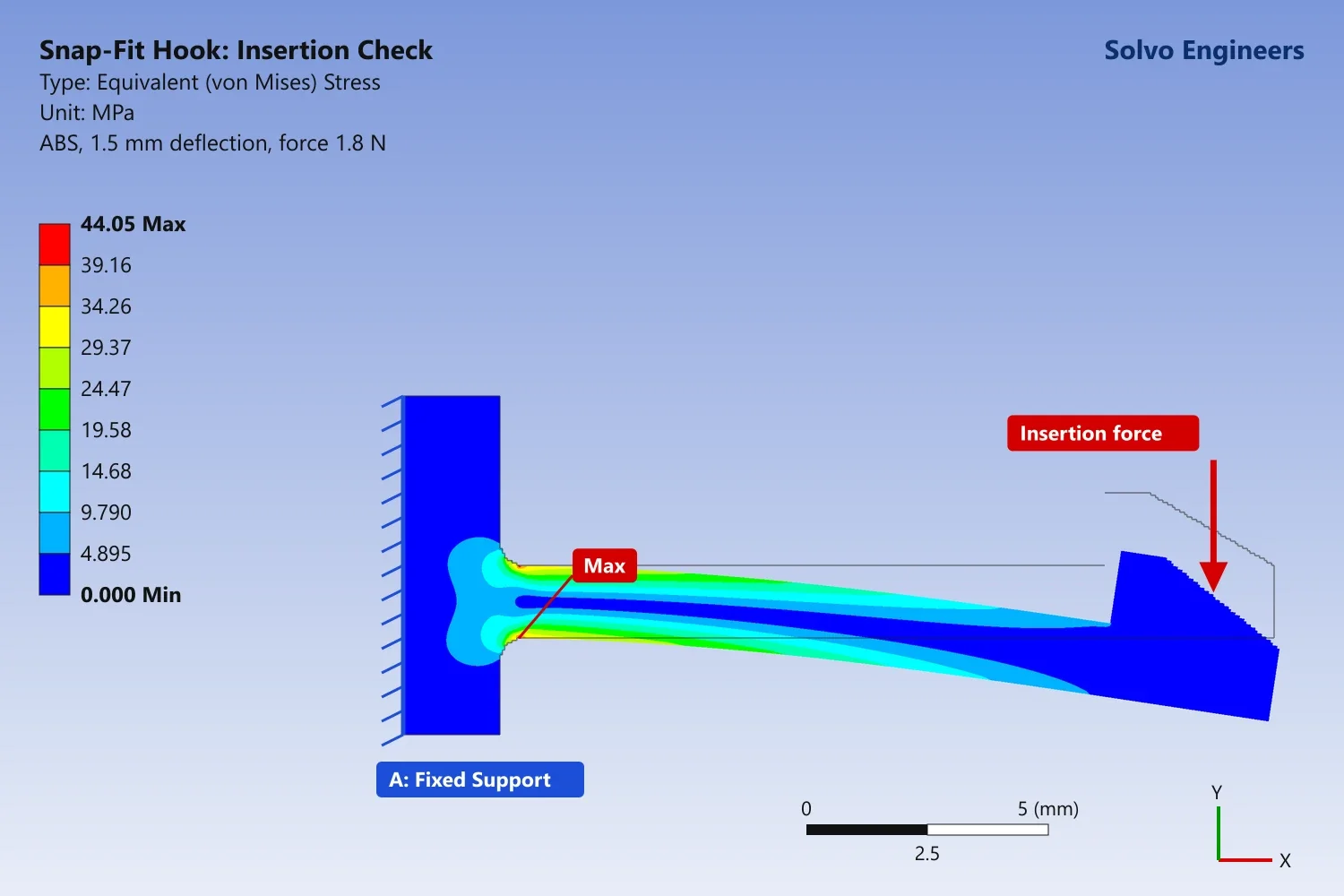
This guide explains how cantilever snap fits work, the formulas that size them, the limits that decide whether they crack, and how Finite Element Analysis (FEA) finds the problems a hand calculation misses. The analysis on this page's cover is a real FEA of an ABS snap-fit hook, and we use its results throughout.
Types of Snap Fit
- Cantilever: a flexible arm with a hook at the end; by far the most common type.
- Annular: a ring that stretches over a bead, as on pen caps and some bottle closures.
- Torsional: a latch that twists about a small shaft, often used where the snap must be released by hand.
The Hand Calculation
For a cantilever arm of constant rectangular section, beam theory gives a quick first estimate:
- Strain at the root: ε = 1.5 × t × y / L², where t is the arm thickness, y the deflection and L the arm length.
- Deflection force: P = b × t² × E × ε / (6 × L), with b the arm width and E the modulus (a secant modulus at the expected strain for plastics).
- Assembly force: W = P × (μ + tan α) / (1 − μ × tan α), where α is the lead-in angle and μ the friction coefficient.
These formulas are a good starting point, but they assume a sharp, perfectly fixed root and a uniform arm, and real snap fits have neither.
What the FEA Shows: A Worked Example
The cover image shows an FEA of an ABS hook with a 1.5 mm thick, 2 mm wide arm, a 0.5 mm root radius and a 30° lead-in, deflected 1.5 mm, the height of the hook, as it is pushed into place:
- The force needed to deflect it is about 1.8 N, close to the beam formula.
- Beam theory predicts about 37 MPa at the root. The FEA shows 44 MPa at the root radius, about 1.9 % strain: the local stress concentration a hand calculation misses.
- The highest stresses sit at the top and bottom of the root, the places where snap fits crack first.
That level of strain is close to the limit for a one-time snap in many unfilled plastics, so this design would be refined, as explained below, before tooling.
Allowable Strain: The Number That Decides Everything
- Snap fits are designed on strain rather than stress, because plastics have no single clear yield point.
- The allowable strain comes from the resin supplier's design data. It is typically a few per cent for unfilled amorphous plastics such as ABS and PC, higher for tough semi-crystalline ones such as PP and PE, and much lower for glass-filled grades.
- Snap fits that are opened and closed many times need extra margin; suppliers commonly recommend around 60 % of the one-time value.
- Temperature and moisture matter: nylon, for example, gets softer and tougher as it absorbs water from the air.
Design Changes That Prevent Cracking
- Increase the root radius: a sharp internal corner concentrates strain. A radius of around half the arm thickness is a common starting point.
- Lengthen the arm: strain falls with the square of the length, so a little extra length helps a lot.
- Taper the arm: making it thinner towards the tip spreads the strain along its length, so it can deflect further at the same peak strain.
- Reduce the hook height: just enough to hold, no more.
- Choose the angles: a lead-in of around 25° to 35° keeps the assembly force low, while the retention angle sets the holding force (90° for permanent, shallower for releasable).
- Choose the material: a tougher grade can solve a strain problem without changing the geometry.
How We Analyse Snap Fits
- A nonlinear analysis with large deflection, contact and friction between the hook and the mating part.
- Material data for the actual grade, at the right temperature and moisture.
- Checks of peak strain against the allowable, insertion force against an ergonomic target, retention force, and permanent set after release.
- For snaps under constant load, a check of creep and relaxation over time.
Material choice often matters as much as geometry. In our FEA material comparison of a polymer rod guard, PA11 deflected 2.58 mm at 8 N while polycarbonate deflected 9.39 mm, about 3.6 times further, under exactly the same load. Our FEA of a nylon injection-moulded part shows the same attention to fillets and mesh refinement that snap fits need.
Designing for the Mould
Every hook is an undercut. It needs a side action, a lifter or a pass-through hole in the part so a simple core can form it, and each option affects tooling cost. Keep the arm thickness in line with the surrounding walls to avoid sink marks, and add draft where the tool needs it. Our guide to plastic part design for injection molding covers walls, ribs and draft in more detail, and our guide to drop test simulation explains how to check that snaps hold when a product is dropped.
What We Need to Start
- 3D CAD of both mating parts, or drawings for our 3D CAD team to model.
- The plastic grade, or the candidates you are choosing between.
- Whether the snap is permanent or opened often, and the target assembly and retention forces.
- Operating temperature range and environment.
Frequently Asked Questions
Why do snap fits crack?
Usually because the strain at the root exceeds what the plastic can take: a sharp root corner, an arm that is too short or thick, a hook that is too high, or a brittle grade.
Is the hand calculation good enough?
For a first size, yes. It misses the stress concentration at the root and the flexibility of the wall the arm is attached to, which is why the cover example shows about 20 % more stress in FEA than in beam theory.
Which plastic is best for snap fits?
Tough materials with a high allowable strain, such as PP, PC and unfilled nylon, are the easiest. Glass-filled grades are stiff and strong but need much gentler snap designs.
Can you check a snap fit that is already failing?
Yes. We model the existing design, confirm why it cracks or loosens and test fixes before the mould is modified.
How do we get a quote?
Send your CAD files and the plastic grade through our contact page. We will reply with a scope, timeline and quote.
Get Snap Fits Right Before You Cut the Mould
Our engineers can check your snap fits for cracking, assembly force and retention, and recommend the geometry or material change that fixes them. Send us your CAD files and material, and we will reply with a clear scope and quote.